6.03.2018

Focus Stacking for May Flowers

I did a lot of focus bracketing and stacking last month.  Both my Olympus and Panasonic cameras have a focus bracketing feature that allows me to focus on the closest part of the flower with the first shot, followed automatically by sequentially further focused shots thereafter.  The beauty of this feature is that this is done with one press of the shutter and at a speed of approximately 10 frames per second.  I then combine the images on my computer using Zyrene Stacker.

Iris

Columbine (wild)


Both cameras were set for 25 images (the maximum is 99) and both cameras allow you to dial in the distance you wish there to be between shots.  Some trial and error is required, because the distance options are 1 through 10, with 1 representing the shortest distance, but none of these numbers are defined.  As far as I can tell the distance varies depending on the subject distance. In all cases I used a distance of "2".

Fern (wild)

Fern (wild)

Only in the Pansy image at the very bottom here did I need 25 images to cover the flower from front to back.  In all other cases it was 4-18 images and on average I needed 11.  Twenty-five images was generally overkill, and the unnecessary ones were just deleted on my computer.  Perhaps the Pansy needed 25 shots because I shot at F2.8 (the others were at F4) and I was very very close.

Trillium (wild)

Fern (wild)

All but the last two were hand-held.  I was able to hold the camera (sort of) steady because I was either sitting cross-legged or was sitting on a folding stool I bring with me.  Either way, my elbows were firmly propped on my knees. But the "elbows on knees" technique is not as stable as a tripod.

Wood Poppy (wild)

Trillium (wild)

The final two images were taken on a tripod.  I think I will use the tripod more, going forward.  I find the tripod reduces the apparent movement of the flower between shots.  It is not a matter of images being sharper, as the shutter speed is sufficiently high to get 25 sharp shots even hand held. But the more movement there is of the flower (and/or camera!) during the 25 shots, the more difficult is it for the software (Zyrene Stacker) to align the images. Hand held images show more movement (change of position?) of the flower within the frame, from shot to shot (though the images are sharp), because the camera moves between frames, while images taken on the tripod show less movement of the flower from shot to shot. Obviously I am unable to hand hold without moving during the three seconds or so it takes to take 25 images. The side to side movement is obvious when viewing the location of the flower in the images, and I am guessing that there is some (but less observable) movement back and forth.


Wild  Geranium

Wild Geranium

Tulip

Wood Poppy (wild)


Trillium (wild)

Spiraea

Guelder Rose

Lilac

Rhodedendron (first bloom of the season)

Pansy

6.02.2018

An Additional Blog for my Wife and Me: Essentially Cooking

I've been working on Essentially Cooking for a while.  One of the fun things about a new blog is doing a "build out", choosing the format, colors, etc. I'd like to get better at food photography, but right now the images are being taken "on the fly" as Laurie works in the kitchen getting dinner ready. She's a great cook and is always experimenting.

essentiallycooking.com


5.23.2018

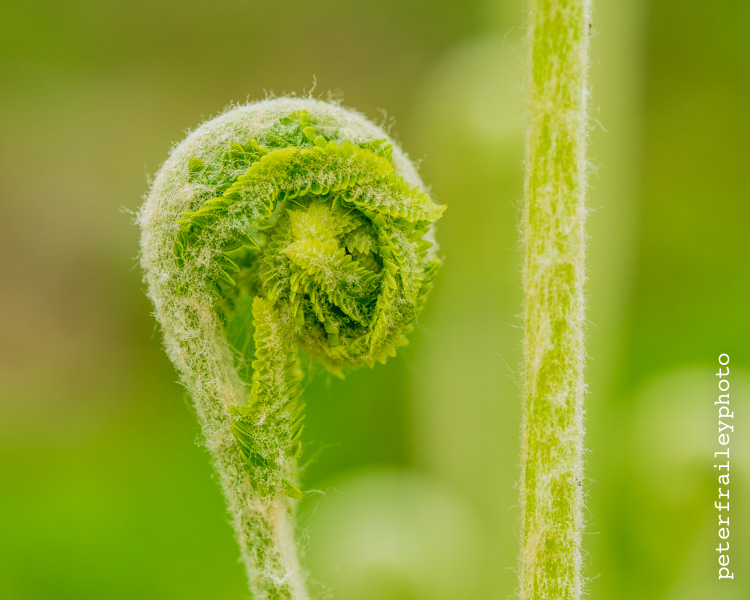
Emerging Ferns are so Intricate and Detailed

Below is a set of photos from a recent trip to the woods, all ferns in the wild with their fiddleheads unfurling (for lack of a better word) ... so intricate and full of details. All of this season's fronds are wrapped up inside the fiddlehead.

I read a few introductory pages of the "Peterson Field Guide to the Ferns".  I found it rather amazing that worldwide there are about 10,000 species of ferns covering almost all ecosystems. This includes mountains and swamps; in sunny open fields and dimly lit wet crevices; on high, dry windy cliffs and on still waters of ponds and lakes; in the Arctic and Antarctic Circles (though sparingly) and tropical jungles (in great quantities). The only exception seems to be desert ecosystems.

Unfortunately all I know about the images below is that they are ferns.  I have no idea what specie(s) is/are represented here.

All photos were shot with the Panasonic GX80/85 and Olympus 60mm macro.


5.20.2018

The Beautiful White Trillium Wildflower


An  array of White Trillium... from white to pink as they age.


After taking a few photos of the wildflower Trillium last week, I did some reading about it. There are dozens of species.  I believe what I am showing here are called Eastern White Trillium.  It is the official flower of Ontario and Ohio.  As the name suggests, the flower has three petals that rise above what is called a whorl of three leaf-like bracts.  


Some online sources say that the flower turns purple as it ages.  Others say it turns pink.  But according to my Audobon Field Guide to New England, the White Trillium will turn pink, and there is separately a Purple Trillium species. 


One source mentioned that this is one of many plants whose seeds are spread by ants.  As I understand it, the plants produce small fruits that attract ants. The ants take the fruits to their nests, where they eat the fruit and discard the seeds. Apparently an ant colony's “discard pile” provides a very rich growing environment for the seeds.


Each of the images in this post were created by focus stacking 10 images
Panasonic GX80/85 with Olympus 60mm macro
1/125sec, F2.8, ISO200
Hand held, sitting with elbows on knees

5.16.2018

One Photo: Happy Belated "National Chocolate Chip Day"

It's horrible!  I missed yesterday's National Chocolate Chip Day.  So, I figured I'd better celebrate today, belatedly, with a couple of these bad boys: Traditional Toll House cookies.

With Mother's Day having been this past Sunday, Toll House cookies make me think of my mom, who frequently had batches coming out of the oven as my brother and I walked in the door from the school bus. It doesn't get much better than warm cookies and milk.  (I'll ignore the fact that she used "Crisco" because butter was too expensive.)

Panasonic GX80/85 with Olympus 60mm macro
1/60sec, F5.6, ISO400 (-1.0 EV so I could add a flash)
Diffused and bounced flash at 1/2 power


5.11.2018

The Joy of Big Prints

For most photographers these days our photos easily find their way to our websites, blogs, online portfolios, or are emailed to family and friends as .jpeg attachments. All of these are digital images.  It is for this reason that I do not own a good printer.

Rarely do we -I'm generalizing- make prints. Personally, I desire prints infrequently enough that I find it easier to just upload files to an online vendor. It may actually be cheaper this way, as I hear about photographers buying new (and better?) printers before the old ones have died. That buying strategy is not cheap, as the half-used printer is basically given away, at a "pennies on the dollar" price. I also hear about dried up ink cartridges. They are not cheap either.

I'm afraid too that if I even slightly open the door to doing my own printing, I'd really get into it and would soon find myself buying all kinds of fancy papers and spending way more money and time than I ever expected. 

I think printing is actually a hobby all by itself. Plus I have nowhere to set it all up!

All that being said, there is nothing so satisfying as a nice big print, and I do have some. For the past 10 years I have been using mpix in Kansas City, when I want printing done. If I upload a digital file on, say, Monday it will be printed, mailed and received by me on Thursday, or perhaps Friday. That's not a 24-hour turnaround, but having the process take a few days is fast enough for me.

You can check out their prices online at mpix.com. They are on the high side I believe (at least compared with my second choice, adoramapix.com), but the results from mpix are very high quality and their support is excellent. Two years ago I had several 20" x 30" prints get slightly bent in the mail (the only time in 10 years that happened and I can't remember whether it was their fault or that of the U.S. Mail), I contacted Mpix and they overnight mailed replacements to me at their cost. 

Also, it is worth noting that several times a year I receive emails with discount codes for 50% off on large prints, usually defined as a print equal to or bigger than 11' x 14". I have framed and matted a small number of prints measuring 20" x 30", and quite a few measuring 16" or 18" x 24". The largest size available is 24" x 36".  Prints of that size are mailed in a tube.  Prints smaller than that are mailed is a sturdy flat box.

I have always been happy with the quality of the prints from mpix. Recently I framed two large prints for an office conference room project. I asked that 18" by 24" images be printed on their 20" x 24" paper, as the images had a 4:3 aspect ratio, which is the native aspect ratio of the Olympus E-M1 camera that was used for both images. 


Because they were to be wall mounted side-by-side, I chose two strong subjects that I thought complemented each other: Lower Falls of the Grand Canyon of the Yellowstone in Wyoming and Mount Rainier in Washington.

[The mats, frames, acrylic non-glare glazing, and foam backing were purchased from americanframe.com and were cut to the exact measurements I furnished through their online tools.]

A little more about each image:

Mount Rainier from Reflection Lake
Olympus E-M1 and 12-100mm F4 zoom @ 47mm (94mm equiv)
1/500sec, F5.6, ISO200, -1.7EV

Lower Falls of the Grand Canyon of the Yellowstone, Wyoming
Olympus E-M1 and Panasonic 14-140mm @ 14mm (28mm equiv)
1/640sec, F6.3, ISO200, -1.3EV

4.28.2018

Bloodroot blossoms from a few angles

Walking through the woods yesterday there were not a lot of wildflowers blooming... except for the bloodroots.  These are very simple blossoms.  I am not a particular fan of white flowers as they have very little (obviously) color and are hard to expose correctly.  They also easily show any "wear and tear", so it is important to find fresh clean samples when looking for a composition.  I am pleased with this first image, as the flower seems to be perfectly symmetrical. The bloodroot is a perennial that is native to eastern North America.


4.23.2018

My Favorite Maple Tree is Gone


During the first night of our second of four "nor’easter" storms this winter my favorite maple tree fell to the ground from heavy wet snow and near hurricane winds.  It was one of 14 trees we lost that night. 


Now that it’s gone I remember the great photos it has given me.  The inch worm image was a once in a lifetime capture. And this particular tree was always heavily laden with colorful seed pods each May. 

Feeling nostalgic, I did some searching in my Lightroom catalog for images, and came up with a few.

Taken in May, 2008
Olympus C8080 bridge camera with 2/3" sensor

Taken in May, 2014
Sony NEX-6 with I think an old manual focus macro lens

Taken in May, 2014
Sony NEX-6 and unknown manual macro lens
Likey a Tamron 90mm with adapter

Taken in May, 2014
Olympus E-M1 and 60mm macro lens

Taken in May, 2017
Olympus E-M1 and 12-100 F4 zoom @ 54mm

4.19.2018

Using the App "GardenAnswers" to Identify Flowers


I’ve been learning a bit about flowering plants with an app on my iPhone. I can’t recall if I’ve commented on “GardenAnswers” here on a prior blog post or not, but I’ve been using the app for a year or so.

My last blog post included a few crocuses I had photographed at a nearby garden, Tower Hill Botanic Garden. A crocus is one of just a few flowers I can identify. I know a pretty flower when I see it, but most of the time I have no idea of its identity.

“GardenAnswers” has come to the rescue. All I need to do on my iPhone is open the app and then take a photo of the flower or search my photo album for a photo already taken.  I guess it is like face recognition technology, as the app analyzes the photo and gives samples of flowers that look similar. You can then pick the one that best matches. The app will give you the matching flower’s common and scientific names, and a brief description of some of its characteristics.

This all works smoothly almost always. When it doesn’t, and no adequate samples are found, you have the option to send the image to one of their horticulturists for identification.  The cost is $1.

"Glory of the Snow".  An early season flowering bulb
Olympus E-M1 and 12-100mm zoom @ 86mm (172mm equiv)
1/800sec, F4, ISO200, +.7EV


This is how I used the above image and “GardenAnswers” this morning, an app on my iPhone. 

I picked "photo album" as the image was already in my phone library

I matched my photo (top) with the photo their software picked (bottom)

I confirmed the match and received an identification and description

4.15.2018

Spring-Time Flowers

It's been a roller coaster couple of months in New England. After feeling very sure that the snow was all over, today we just had the coldest April 15th in recorded history, with an occasional snow flurry or "snizel" (i.e a combination of snow and drizzle).

The high temperature was surprisingly at midnight, which was 38 degrees at our house, and the temperatures fell all day.  As I write this at 8pm, it is 32 degrees.  Boston reported windchill near 20 degrees.  

Tomorrow is the Boston Marathon.  It will be windy (15-40 mph) and rainy, with temperatures in the mid-30s when the race starts and perhaps low 40s by mid-afternoon. I see an 80-100% chance of rain for every hour from 8am to 2pm.  

All that yuckiness aside, I spent a warm and wonderful two hours outside at the botanic garden two days ago.  Many of the outside areas were roped off because they were undergoing maintenance (and looked very muddy), which I guess should be expected after the heavy (and just recently melted) snow this winter.  Nevertheless, I did take some pleasing photos of a few of the spring-flowering bulbs.

Below is a selection.  

Gear: The first image, that of a "snowdrop", was taken with my Panasonic GX80/85 and 60mm Olympus macro lens.  The rest are all crocuses of various colors and the photos were taken with my Olympus E-M1 and Olympus 12-100mm zoom lens.