Showing posts with label butterfly. Show all posts

5.20.2013

Behind the Scene: The Leopard Lacewing Butterfly

Over the last several years I have been collecting quite a number of butterfly images.  This is thanks to a nearby butterfly house.  This does feel a little bit like cheating, however.  Sort of like visiting a zoo to get photographs of African animals.  On the other hand, the local butterfly house is quite a bit cheaper than traveling to exotic butterfly havens like Costa Rica. 

One of my new projects is to identify and label my collection of images.  A favorite of mine is called the Leopard Lacewing.  In doing some research online, one Web site called this one of the seven most beautiful butterflies in the world.  Who am I to argue with that!

What I like so much about the Lacewing butterfly is the ornate underside.  This is a bold pattern with lots of dots and bars, and many colors. With a little bit of "fill flash" from a flash with diffuser mounted on my camera's hot shoe, the colors come out very nicely
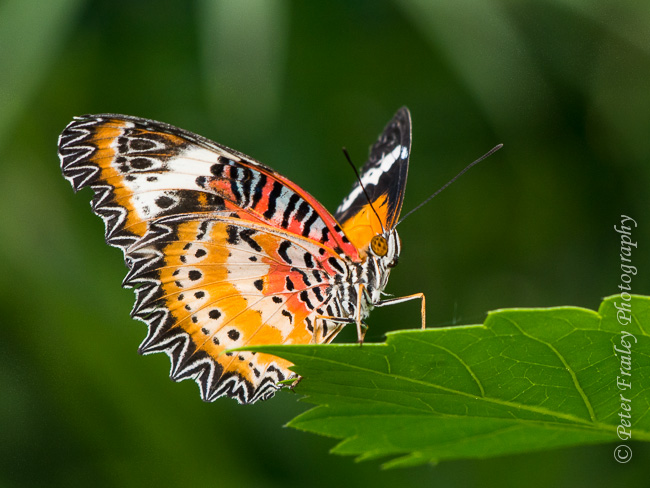
This is my most recent image, taken a couple of weeks ago. I think this specimen
stands out nicely against an all-green foreground and background.
As I recall, the flip-out display on my Olympus E-M5 made it easy to hold the camera
at waist height to capture the butterfly at this angle.
1/200th; F8, ISO400 and a touch of fill flash.


Topsides the Lacewing is also beautiful and I have posted an image below showing the vibrant top of the wings.  The bright orange indicates that this is a male.  Apparently the female is a bit drab, with gray instead of orange.  I don't seem to have a picture of a female. I'll have to keep my eye open for one next time.

The Leopard Lacewing is found in India and Southern China, down through the Malay Peninsula and Singapore.

1/650th; F8, ISO400 and a touch of fill flash.
(If I were doing it all over, I'd drop it to ISO200 and 1/325th)


5.04.2013

Butterflies with the E-M5 plus kit 40-150mm plus Metz 50 AF-1 flash plus deflector

In April I made two trips to Westford's Butterfly Place.  I have been there quite a few times over the last few years, but find that I am still able to "capture" new varieties.  Hopefully, too, I can get better and better images of some of the varieties I already have in my growing "collection" of tropical butterfly photos.

Earlier this year I acquired for $100 a brand spanking new Olympus 40-150mm zoom for m43.  It works rather nicely with a 3 foot focusing distance when zoomed to 100mm to 150mm.  At 150mm I can fill the screen with a composition 4" across.  I usually start with the lens at 150mm and zoom out if I want to add more environment to the image.  Of course, I can always back up.

My standard lens for flower and butterflies had been the 70-300mm designed for reg43 bodies.  But on the m43 body it focuses slowly and noisily.  That's okay for flowers but not so much for things that move. The 70-300 is sharpest when zoomed to 100-150mm, and focuses at about 3 feet.  But it has slightly more magnification than the 40-150.  At 150mm I can fill the screen with a composition that is 3" across.

Nevertheless, I think the 40-150 for m43 is a better choice for me.  It focuses fast and quietly and is very lightweight, which I notice after my (typically) two hour butterfly sessions.  By the way, the 40-150 is light because it is all plastic, even the lens mount.  I'd rather have a metal lens mount, but for $100 I have nothing to complain about.  As far as I can tell the optics are excellent in the range I am using for butterflies and at my preferred aperture setting of F8.  Though I don't get quite the magnification I have with the 70-300, a bit of cropping isn't particularly problematic with the 16 megapixel sensor of the E-M5.  When I started with the 70-300, it was on the Olympus E-520 which was a 10 megapixel sensor.

I used a flash during both April sessions.  The flash is a Metz 50 AF-1 to which I attached a cheap deflector.  I also have some other deflectors I expect to experiment with.


I used manual exposure settings.  Almost always I shoot at 1/250 and F8 and whatever ISO is required to provide underexposure of about one stop.  I then set the flash at TTL.  I use flash exposure compensation if adjustments need to be made.

Below are my two favs from April.  Neither specie was in my collection so I was happy to have seen these specimens and also to have found them in perfect condition.

Emerald Swallowtail

White Peacock
The rest of the images from my two April outtings can be viewed on my Web site, here:

9 images from April 7 at

9 images from April 20 at

5.06.2012

16 Best Butterflies from yesterday

[Update: Actually, I've done some editing and there are only 12.]

Using a flash on my new Olympus E-M5, I went to our local butterfly house yesterday morning for an hour of shooting. I had a pretty heavy set-up on this little camera, as I used my Olympus 70-300 zoom and the 36R auxiliary flash.  [The E-M5 is designed as a small ILC - interchangeable lens camera.]


I can't wait for the extra grip accessory to arrive.  It's on back order.  Having used an accessory grip (often called a battery grip because it allows you to use two batteries) on my Olympus E-620 I am very confident that the optional grip for the E-M5 will greatly increase the handling comfort of this little gem of a camera. 

All of the butterfly images are with this simple flash set up.  I was quite pleased with the results.  I am actually thinking  I may be catching onto the whole flash thing, at least at a basic one-flash-on-board-the-camera level.  My goal is to have the flash light up the subject without having that "deer in the headlights" look you often get when using a flash. 

The next time I try this, I will bring along with me one of the many commercial diffusers which should soften the light from the flash and hopefully help it blend in more with the ambient light.  I've actually purchased a couple of cheap options, but forgot to put them in my bag for this outing.

The 12 photos are on my Web site, here:

http://www.peterfraileyphoto.com/butterflyplace2012may5

5.05.2012

Olympus E-M5: Post #5: Butterflies

For folks interested in the new Olympus E-M5, I have posted on my Web site 3 images of each of 16 photos of butterflies taken today.  The link is below.

This is for geeks.  In each case I am showing (1) the Olympus out-of-camera JPEG followed by (2) Colorchecker Passport JPEG from RAW in Lightroom 4, and (3) Adobe Standard JPEG from RAW in Lightroom 4.

Yes, there are subtle differences, but I only notice it on larger sizes. To my way of thinking "the differences between them don't make a difference."

Below is one example.  See!  No (significant) differences.

The rest are on my Web site here:

http://www.peterfraileyphoto.com/butterflies2012may5


4.11.2012

A few butterflies from our local butterfly house

I love the exposures I got on these butterflies this past weekend. The glass canopy at Westford's Butterfly Place is a very effective light diffuser, but in addition there were slight overcast conditions.

I enjoyed every minute of my 1.5 hour "shoot" last Saturday.  The Butterfly House opens their door an hour early for photographers, a couple of times per month.  It's $3 extra on top of the normal $12 daily charge.  Because I went there a bunch of times last year, I bought 10 daily admission coupons discounted to $60. There's no expiration date.

One reason I like this first hour is that the owner leaves the heaters and blowers off, which keeps the butterflies a bit lethargic and therefore more captive subjects. 

Unfortunately many of the specimens I found were rather beaten up.  The walls around the butterfly house are concrete block material, perhaps 20 feet high.  The roof is made from glass panels.  I recall someone saying that because the butterflies hover and rest frequently in the upper corners of the concrete walls that it is against the rough concrete that their wings get a bit beaten up.

Below are a few small images.  I have a set of 22 larger images posted on my Web site, here:

http://www.peterfraileyphoto.com/butterflies2012apr7


9.17.2011

Butterfly page updated to include 55 images

I just had some fun going through all of my butterfly images.  I have about 250.  I've selected 55 which I think are good enough to upload to the Web site.  The selection can be viewed at:

http://www.peterfraileyphoto.com/butterflies

4.02.2011

My first butterfly images this year

I took an early morning trip to our nearby butterfly house this morning.  They open the doors an hour early for photographers on the first Saturday and Sunday of the month, during the season.  I like that first hour because the fans and heaters aren't yet going full blast, so the butterflies are still a bit sleepy.  I am pretty happy with the shots I took (link below).  All are taken hand-held at 1/250 second and (usually) F8.  Mostly ISO at 1600, with a few at ISO 800.  My camera settings: Manual mode set at my desired shutter speed and F-stop, and auto ISO.  All are with natural light, diffused somewhat through the glass dome of the butterfly house.

12 images here:

http://www.peterfraileyphoto.com/butterflyplace2011apr2

My favorite is the Glasswing.  Below are two images:


10.29.2010

Flora and Fauna group of galleries added

I have just added a Flora and Fauna group to my "all galleries" page, and have included two galleries within the group: Dragonflies and Butterflies. 

A couple of my favorites are below at the maximum blog size of 650 pixels wide and/or long.  The images will be somewhat larger in the galleries.


The dragonfly was taken with an Olympus E520 dSLR and 40-150mm Olympus zoom lens equipped with a Canon 500D closeup lens screwed into the filter threads.

The butterfly was taken with an Olympus E520 dSLR and 70-300mm zoom lens with a built-in macro feature.

8.22.2010

A morning photographing butterflies

Earlier this month I spent the morning photographing butterflies at the Butterfly Place in Westford.  I am partial to the wings-up pose, even though the underside of the wing is often dull in color compared with the top of the wing.  Below are three wings-up images.  I have posted about 10 butterfly images from my outing, showing various angles, on my photography Web site here:

http://www.peterfraileyphoto.com/butterflies2010aug7


3.19.2010

Learning to photograph butterflies

I'm lucky to live near two butterfly houses. My first experience with captive butterflies was last spring when our photoclub went to The Butterfly Place in Westford, MA. We rented the facility for an hour for a small fee, which provided us with access on a Saturday before the normal 10 a.m. opening. We could stay as long as we wanted; but the advantage of that first hour was the greenhouse (for lack of a better word) was still cool from the lower nighttime temperature. This meant the butterflies were sluggish and easier to photograph, until the heat and fans were turned on at 10 a.m.

I used a Panasonic FZ8, a camera known as an "ultrazoom" because it provides an optical zoom lens with an equivalent field of view of 35mm (moderately wide angle) to 420mm (nice telephoto). One feature of the Panasonic ultrazooms is something called a "telemacro". What this does is provide a partial macro feature at the full zoom of 420mm. The result is that a 4" wide object (for example, a butterfly with a bit of background) can fill the viewfinder, all at a convenient focusing distance of about 33". 

Below are a several of my favorites from that outing. Each was taken without a flash, and the camera was hand-held. The problem with the Panasonic is that because of its small sensor, the noise level at even ISO 200 is a bit on the unacceptable side. I used software to reduce the noise.  Also, due to the smaller sensor the depth of field is greater than a dSLR, which can be good but also means backgrounds are more in focus and therefore often distracting.


The second butterfly house is in Deerfield, MA and is called Magic Wings. This winter I went there during normal hours and had a difficult time because the butterflies seemed to be in constant flight. Below are a few of the images I was able to get.

This time I had an Olympus E-520 dSLR with a 70-300mm zoom lens. This lens provides an excellent macro at full zoom. A 1.5" subject will fill the viewfinder. And at 150mm, where this lens is known to be sharper, a 3" subject will fill he viewfinder. All this at a focusing distance of about 40".

My camera was set at Shutter-priority, with Auto ISO. I used 1/500th second shutter setting but will want to try 1/250th next time so as to use a lower ISO.  My exposure meter is set to center-weighted. I use EV compensation depending on the darkness/lightness of the subject butterfly. Again, no flash was used, and the camera was hand-held. 

Note that the backgrounds on this second set of images are blurrier and softer.  This is because the depth of field is so much less on a dSLR at equal aperature openings.


Finally, I'd like to mention a good online resource, http://www.learnaboutbutterflies.com/, which also has a section on butterfly photography.