Showing posts with label panasonic lx5. Show all posts

11.19.2012

Sony NEX-6 versus Panasonic LX5: Some final thoughts

For the past few days I have been comparing the image quality of the Sony NEX-6 and its kit 16-50mm zoom against my Panasonic LX5, an "advanced" point and shoot camera.  The posts I wrote based on these comparisons can be found below today's post.  (Or enter "NEX-6" in the search tool.)


The Sony pretty handily beats the Panasonic for image quality, both in the center and at the edges, at the three comparable focal lengths I tested.  That shouldn't be surprising because the sensor on the Sony has 8x the surface area of the Panasonic.  But since most of my travel and landscape photos with the LX5 have been at low ISO (rarely as much as ISO 400) where sensor size is not as critical, and since I have always thought the images coming from the LX5 were "good enough", I thought I would use the LX5 as a "good enough" benchmark.  The Sony 16-50 beat my benchmark!

I like the Sony a lot. Especially with the pancake zoom it balances nicely and feels very comfortable in my hand.  I can even operate it with one hand, just like I do with point-and-shoots.  But, I'm not exactly sure how it will fit into my style of photography (which includes the Olympus OM-D as well as the LX5).  I'm thinking I might take it when I would otherwise take the LX5; however, the Sony is about 60% heavier. The LX5 fits in the pocket of my jeans, while the Sony fits in a jacket pocket. Lots to think about.

My next experiment is to compare the 16-50 image quality against my Olympus 14-54II.  The 14-54II is supposed to be a step above a standard kit zoom.  It's also a bit faster, perhaps by one stop overall.  I would expect it to sharper, too. But you never know.  You can buy the 16-50 for $350.  The 14-54II sells for about $600.

Back to comparing the NEX-6 and LX5.  Here are a few final thoughts:

I love the focus peaking feature of the NEX-6.  I have five old Nikon lens that work beautifully with the NEX-6.  (You do need to buy an adapter, however... about $20 on eBay.)  And, while using old manual focus lenses,  I like the implementation of the manual focusing and magnification feature on the Sony better than the Olympus.  Yes, I know that Sony has no in-body stabilization but all my Nikon lenses are of short focal lengths where I would use a shutter speed of 1/focal length anyway. I don't really need stabilization with them.

The histogram on the NEX-6 easily surpasses the LX5.  I use the histogram all the time and appreciate the RGB color channel histograms that can be reviewed after each image is taken.  A big plus with the NEX-6 (and one of the reasons I didn't jump for the 5N or 5R) is the EVF.  Another reason for buying the "6" instead of the "5" is the addition of a built-in flash.  It is not particularly powerful but I like the fact that it can be pulled back to bounce the flash off the ceiling.

The LX5 has some pretty advanced features, too.  I am surprised that the ones I like and list below are not also in the Sony.  The LX5 has an size-adjustable single focus point.  It can be made much smaller than the fixed size on the Sony, which I find very helpful for closeups.  And speaking of closeups, the macro at 24mm is a very helpful tool on the LX5.  Other great features include setting a minimum shutter speed (in P-mode) and being able to use Auto ISO in manual exposure mode.

One final note is that at this writing the new NEX-6 plus 16-50mm lens retails for about $1,000.  You can buy the two year old LX5 for $250 at Amazon.  And the new LX7, which seems to be sharper than the LX5 and has a faster lens, is selling for $449.

11.18.2012

Sony NEX-6 plus 16-50mm v. LX5 at 70 mm equiv.

This is my fourth post about the Sony NEX-6 and the new pancake 16-50 kit lens. In the previous posts I compared it with my beloved Panasonic LX5 at 24mm-e and 50mm-e. So far, and as I had hoped and expected, the 16-50 kit lens on the NEX-6 provides sharper images with less noise than the LX5, at the focal lengths tested. 

This conclusion comes from pixel peeping, usually at 100%.  But at normal viewing distances I don't think the difference really makes a difference.  Just for fun I expect to print a few of these comparative images to see if there is a difference in small or medium sized prints, again when viewed at normal distances.  Of course, as the print size increases past, say, 10" x 15", I would expect the Sony to be noticeably sharper.

Also, with lower light levels, I suspect the Sony with its much larger sensor will begin to put the LX5 to shame, in spite of the LX5's faster lens.

In the prior posts I compared the two at 24mm and 50mm equivalent. 

Today's images

The images below were taken hand held at 70mm equivalent. At this setting, the LX5 is at its best at F4. The 16-50 at 50mm-equiv seems equally good wide open at F5.6 or at F8. For the comparison, I chose to use the F5.6 sample.  I used the lowest ISO: 80 for the LX5 and 100 for the Sony. I shot RAW, used Aperture Priority and Auto White Balance. What you'll see below is that the Sony is sharper than the LX5.

Post Processing

I imported the RAW files from both cameras into Adobe Lightroom 4 (LR4). I used the default Adobe color profiles. Unlike my experience with the Sony RAW file at 24mm-e and 50mm-e, I did not correct for any distortion at 70mm-e, as I didn't notice any.

I added sharpness and clarity to both images. The Sony took more sharpening than the Panasonic without looking crunchy, so the Sony got a bit more sharpening. I also using the CA tool to get rid of the purple fringing in high contrast areas of the LX5. I saw no CA in the Sony image.

Finally, I downsized the Sony to the size of the Pany and created JPEGs at the 100% quality setting. That meant a pixel width of 3776. The JPEGs were brought back into LR4, and I used the X-Y comparison tool in the LR4 Library module to view the images side-by-side at 100%. These are screenshots of those comparisons.


The comparative image. The Sony is on Left.
Click on image to view BIG.
 
 
Center tiles.  Sony (left ) is sharper.
Click on image to view BIG.
 
Upper left.  Sony (left) is sharper.
Click on image to make BIG.

Upper right.  Sony (left) is sharper.
Click on image to make BIG.
 
 Lower left. Sony (left) is sharper.
Click on image to make BIG.

Lower right. Sony (left) is sharper.
Click on image to make BIG.

 
Conclusion:  At 24mm-e, 50mm-e and 70mm-e, the Sony provides sharper images which are also clean of noise.  Even at base ISO, the LX5 shows noise, which you may or may not find bothersome.
 

11.17.2012

Sony NEX-6 plus 16-50mm v. LX5 at 50mm equiv.

This is my third post about the Sony NEX-6 and the new pancake 16-50 kit lens.  In the previous post I started comparing it with my beloved Panasonic LX5.  Albeit, the two are strange bedfellows as the LX5 is a small sensor 10mp camera and the NEX has that nice 16mp APS-C sensor. But in many ways the NEX plus pancake zoom is just a bigger version of the LX5.  Perhaps 60% heavier and 60% bigger, but with a very similar zoom range.

In the prior post I compared the two at 24mm equivalent.  Sony seems better in the center and at the edges.  But to be honest, when viewed as big as  possible on my 24" HD monitor (1920 x 1080) or my large HD TV, I really can't tell the difference when viewed at normal viewing distances.  Either way, both images need to be downsized to about 2mp to be viewed on a monitor or HD TV (1920 x 1080 equates to about 2 million pixels or 2mp).  My guess is that even a 10" x 15" print would not show the difference if viewed about 24" away. All that being said, all the picture I took were done in good light with the Panasonic ISO at its lowest 80 and the Sony at its lowest 100.  All bets are off when the light goes down.

Today's images

The images below were taken hand held at 50mm equivalent. At this setting, the  LX5 is at its best at F4. The 16-50 at 50mm-equiv is at its best at F8 and at its worst wide open at F5. I used the lowest ISO: 80 for the LX5 and 100 for the Sony. I shot RAW, used Aperture Priority and Auto White Balance. What you'll see below is that even at its worst (F5), the Sony is sharper than the LX5 at its best (F4).

Post Processing

I imported the RAW files from both cameras into Adobe Lightroom 4 (LR4). I used the default Adobe color profiles. Unlike my experience with the Sony RAW file at 24mm-equiv, I did not correct for any distortion as I didn't really notice any.  To match the incamera JPEG, I moved the LR4 distortion slider modestly, to +5.

I then added sharpness and clarity to both images. The Sony took more sharpening than the Panasonic without looking crunchy, so the Sony got a bit more sharpening. I also using the CA tool to get rid of the purple or green fringing in high contrast areas like tree branches.

Finally, I downsized the Sony to the size of the Pany and created JPEGs at the 100% quality setting. That meant a pixel width of 3776.  The JPEGs were brought back into LR4, and I used the X-Y comparison tool in the LR4 Library module to view the images side-by-side at 100%.  These are screenshots.

For 50mm equivalent field of view, my conclusion is that even at its worst (wide open at F5), the Sony beats the LX5 at its best setting (F4).


The comparative image.  Sorry they don't line up too well.
These were handheld.
The Sony is on Left.  Click on image to view BIG.


Upper left corner: Sony sharper
Click on image to view BIG

Upper right corner: Sony sharper

Lower left corner: Sony sharper

Lower right corner: Sony sharper


11.15.2012

NEX-6 plus 16-50mm v. LX5 at 24mm wide angle

In my previous post I mentioned my recent purchase of the Sony NEX-6 and the new pancake 16-50 kit lens.  On the Internet there seems to be lots of negative talk about this new lens.  Because it is one of the reasons I bought the NEX-6, I decided I would see how it performs against my most similar camera/lens combination, the Panasonic LX5. The LX5 has an equivalent zoom range of 24-90, and the Sony 16-50 has an equivalent zoom range of 24-70. The LX5 has a much smaller sensor, so I am pretty sure I could crop a 70mm image taken with the Sony to the size of the LX5's 90mm image and actually have a larger file size and more detail.  I'm looking forward to checking that assumption out.

The LX5 weighs 10 ounces including card and battery.  The NEX-6 plus 16-50 weighs 16 ounces.  The NEX-6 is bigger in size: while the LX5 is marginally pocketable (unless you wear tight jeans), the NEX-6 requires a jacket pocket.  I am thinking of using one of the new sling-straps, since I dislike neck straps.

The Panasonic is a small sensor camera so is at a disadvantage when it comes to image quality, but I have always found the images sharp (or at least "sharp enough").  If the new Sony pancake is at least as sharp, then I will be happy.

I will start posting some comparative images. 

Today's images

The images below were taken at 24mm equivalent.  The F-stop range shared in common by the LX4 and the 16-50mm lens is F3.5 to F8.  I know from my own two year use of the LX5 and from the Imatest results on the Internet that the LX5 is sharpest at F4, pretty much throughout its zoom range.  The 16-50 at 24mm-equiv seems to be at its best at F5.6.  I used the lowest ISO: 80 for the LX5 and 100 for the Sony.

Post Processing

I imported the RAW files from both cameras into Adobe Lightroom 4 (LR4).  I used the default Adobe color profile. I ran distortion control on the Sony RAW file (as it was not corrected in Lightroom) with the distortion slider set at +50.  This resulted in a RAW file that duplicated the composition of the Sony incamera JPEG.  And it matched the corrected LX5 file. 

I then added sharpness and clarity to both images.  The Sony took more sharpening than the Panasonic without looking crunchy, so the Sony got a bit more sharpening.  I also using the CA tool to get rid of the purple or green fringing in high contrast areas like the tree branches in the upper left.  Interestingly, just clicking on the box in LR was all that was needed for the Sony.  But with the Pany I had to use the eyedropper to remove CA.

Finally, I downsized the Sony to the size of the Pany and created JPEGs at the 100% quality setting.  The downsizing meant that all the JPEGs measured 3776 pixels wide.  The JPEGs were brought back into LR4, and I used the X-Y comparison tool in the LR4 Library module to view the images side-by-side at 100%.

My conclusion is that when the Sony is at its best setting (F5.6 and ISO 100) it beats the LX5 at its best setting (F4 and ISO80). Both in the center and especially at the edges. My guess is that as light is reduced that the difference in image quality will become even greater.

Winner at 24mm is the 16-50 on the NEX-6.


The Sony is on top.  When the original image is viewed full size
on my computer monitor at normal viewing distance I
really can't tell the difference in sharpness.


These are 100% crops from the center.  Sony on top.  Not much difference.
 
These are 200% crops.  The Sony is on top.  The difference is a bit more obvious here.
Look at the greater detail in the roof tiles in the Sony image.
 

100% crops from the righ hand edge.  Sony on top, is sharper. And smoother.

100% crops from the left hand edge.  Sony on top, is sharper.

 
Next: comparisons at 50mm equivalent field of view.

11.12.2012

Why I bought the NEX-6 plus 16-50 kit lens

Why? Well, actually I wasn't completely clear on "why" until I wrote this post.  Since I already own an Olympus EM-5 with an assortment of lenses plus a Panasonic LX5 to fit in my pocket, I know the NEX-6 will not make me a better photographer.  But I am nevertheless drawn to it.

First to come to my mind is that I have liked small range-finder style cameras ever since using my dad's old German-built Kodak Retina IIIC 35mm film camera. Also, I prefer using an eye-level viewfinder, and the Sony is currently one of the two cameras in this class that have one.  Fuji is the other.


1955 Kodak Retina IIIC and 2012 Sony NEX-6


The first NEX was not of interest to me because, though it had a high quality LCD, it lacked an eye-level EVF. The other problem I saw was not-so-high-quality lenses (at least compared with what was available with the m43 system). The lenses were also pretty large and therefore seemed out-of-balance on the very small NEX bodies.

Well, the new NEX 6 has a state-of-the-art EVF and a new kit lens. I received mine last week, just two days after it became available at BHPhotovideo. The new kit lens is a "pancake" zoom lens, and measures only 1" long when retracted (1.25" with lens cap!) It weighs only 4.1 ounces.  I love the new lens' 12-50mm range (24mm to 75mm equivalent), especially the 24mm wide angle. If Sony were only offering the more traditional kit zoom range of 18-55 I would have passed on the entire kit.

With the NEX 6 body I only paid an additional $150 for the lens, which when purchased separately retails for $300. Alternatively, I could have paid $400 for the Panasonic pancake zoom with its effective field of view of 28mm to 90mm. The Panasonic lens is fully compatible with my Olympus EM-5. It's a small lens but lacks the 24mm wide angle I find so useful.

Another choice is the perhaps more useful zoom range of the new Olympus 12-50mm zoom with its effective field of view of 24mm to 100mm.  But this lens measures 3.25" and weighs 7.1 ounces. Even on the smallish EM-5 this is not a small package.

So, the NEX-6 and kit 16-50mm (1) is a small package considering the APS-C sensor, (2) has a superb EVF, and (3) balances nicely with the new pancake zoom that starts with an equivalent 24mm wide angle.

All that being said, I want to be sure the lens has adequate sharpness. I worry about this with any kit lens. It doesn't have to be super sharp, but it does need to be "sharp enough".

I will be testing it first against my beloved Panasonic LX5, an advanced-featured compact camera. I have been very happy with the images I get from the LX5 with its Leica 24-90mm lens. I am very curious as to how these cameras will compare with regard to sharpness.

But beyond sharpness, I have no question that the Sony with its vastly larger sensor will provide greater dynamic range and color depth.  Too, the Sony should provide more detail in low contrast areas, such as grass. I expect from what I have read on the DxO Web site that the Sony will have 3 stops better low light performance (i.e. less noise), though the LX5 will gain back 1.5 stops of low light performance due to it's 1.5 stops faster lens (example: LX5 has a F2 lens at 24mm while the Sony has F3.5).

I look forward to posting some of my findings in hopes that this will help others.

Panasonic LX5 and Sony NEX-6


Assuming the lens passes my quality tests, my plan for this camera is to use it as a jacket-pocketable camera for landscape and travel pictures. I am also becoming increasingly interested in street photography. Because I feel a bit anxious while photographing people on the street, I am hoping the small size of the NEX 6 and pancake zoom will make my actions less obvious.

10.29.2011

The Panasonic LX5 shines in Maine, beats my dSLR 85% of the time.

During a two week vacation in Maine this summer, I brought along my little Panasonic LX5 and my bigger Olympus E620 dSLR.  I was quite surprised that of the 660 images I have decided to keep (hard drive space is cheap these days!)  that fewer than 100 were taken with the E620.  That's less than 15%!

[A few trip pictures are included below.  I have posted about 35 images on my Website, here: www.peterfraileyphoto.com/mainevacationjunjul ]


All pictures were taken in RAW + JPEG, and both cameras have full manual controls.  When it comes to one important feature for me, the LX5 is better: it has a broader f-stop range for 3 shot exposure bracketing. You can bracket up to 3-stops, compared with only 1-stop on the Olympus. And it is easier to get to the bracketing on the LX5 because you are able to program the function button for that purpose.  The Olympus takes a lot more clicks to get into the bracketing. 


Another nice feature of the LX5 is the 24-90mm equivalent lens. I prefer this over the 28-108mm equivalent lens on the E620. 


When I say that the LX5 beats my Olympus E620 85% of the time, I am not talking about image quality.  I am talking about usability.  Especially for landscape and travel photography. As a tool, I picked the LX5 85% of the time during this trip.  This wasn't planned, it just happened.  It wasn't because I expected better image quality.  It was based on a subliminal mental formula: (camera to carry = image quality + size of camera + convenience + ease of use +  fun factor.) 


The image quality piece of the formula was not on this trip as important to me as it might be to others.  That's because I realize that 98-99% of the images I keep on my computer will never be printed. Nor will they ever win any contests, no matter what camera was used.  They will be seen at no wider than 650 pixels on this blog (about 1/3 of a megapixel), or no wider than 1550 pixels on my Web site (about 1.5 megapixels) or no wider than 1920 pixels (less than 2 megapixels) on my 24" monitor or an HD TV.  For this purpose everything I get from the LX5 is "good enough."  Actually, for these images, I usually keep the JPEG and dump the RAW.


Some of the LX5 images from this trip have already been posted previously. No one has told me that I should have had a better camera for any of these. That's not to say these images could not have been improved upon; but improvement has nothing to do with the camera.


As far as printing goes, perhaps 12 images (2% of the 660) might be printed.  At 9" x 12" or smaller it is hard to tell the difference. To be honest, as much as I like the LX5 (obviousy), if I knew which 12 images would turn out to be the best, it is for those shots that I would want the Olympus.


I have posted larger and more pictures (about 35 images) on my Website, here: www.peterfraileyphoto.com/mainevacationjunjul

9.18.2011

Some shutter therapy at Tower Hill Botanic Gardens today

I wanted to get out and take some pictures today.  The sky was awesome and the weather dry and cool, though there with a bit more wind than I like for flower photos.  The drive to Tower Hill is easy for me and I always enjoy stopping at Davidian's Farm Stand for a couple of  Apple Cider Donuts on the way.

Overall there seemed to be lots of flowers, but upon closer examination it was clear than many were past their prime.  But after all, it is the middle of September and summer is almost over.

Based on what I see in the few pictures I did take, the bright day allowed me to easily shoot at high speed even with low ISO and this was sufficient to freeze the action.  I used my Panasonic LX5 for all of these shots.  As always, these are hand-held.


9.11.2011

Club print "salon" entries for September, 2011

The color image was taken at about 5 a.m., near Spruce Head, Maine, while on vacation earlier this summer. The camera was the Panasonic LX5 point and shoot.  I also took images with an Olympus dSLR, but for some reason the compositions I got with the LX5 trumped any improved image quality that may have come from the dSLR with its much bigger sensor.  Indeed, I have been very impressed with the quality of the images that are coming from this small camera. 

Sunrise at Low Tide

The black and white image was taken in Cape Rosier, Maine. It too was taken with the LX5. This storm came upon us very quickly at about 8 p.m. in July. You can see the edge of the front in the distance.  The storm was coming from behind me.

Coastal Storm Front

5.21.2011

Found an old Vivitar polarizer in the bottom of my old camera bag. Fits and works nicely on my Panasonci LX5.

The other day I was cleaning out an old camera bag and found a 52mm Vivitar polarizer.  If I bought it, it was at least 35 years ago and probably more like 40 years ago.  It's the same size as the threads on my even older Nikon 50mm F1.4 lens (I wasn't the first owner of this fine legacy lens).

The polarizer was a bit cloudy coming out of the little clear plastic case, but I cleaned it up nicely with a bit of hot breath and the tail of my cotton t-shirt.  Is there any other way to clean glass!?

I frankly don't know how good this filter is.  And are filters for digital sensors different than those made for film? Does it make a difference?  I have no idea.


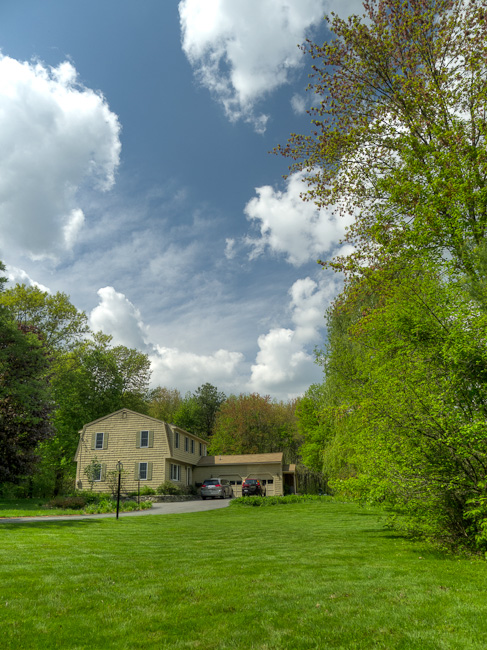
But regardless, it works nicely on my Panasonic LX5 compact camera, even at the widest setting on the 24mm-90mm (equiv.) zoom.... I should have tried a horizontal shot but I wanted to get the clouds and sky using a vertical shot.  Assuming we have another nice day tomorrow I'll give the landscape orientation a try, and see what I get.

The lens adapter is from an aftermarket ebay supplier but the filter end measures 52mm just like the Panasonic adapter. A perfect fit for 52mm filters.  It's nice too because my only other polarizers measure 67mm and 58mm.  I've used 58mm filters on the LX5 with a 52-to-58 step up ring, but using the right size is always slicker.


Anyway, here's the example I was happy with this afternoon.  Nice day, huh?  After a week of rain it was nice to get a reprieve.  Blue and green are great landscape colors.  I am very happy with Panasonic's metering system and always enjoy the live-view histogram.


2.13.2011

Panasonic LX5 tricked out with a couple of accessories - Part II

In Part I, I added a lens adapter to the LX5.  This allows for the addition of auxiliary lenses and filters, and I am finding it is very helpful when hand-holding this small (compared with a dSLR) camera. I find I hold the rubbery camera grip with my right hand (as do all users), but I use my left hand to hold the adapter instead of the camera body.

Of course, the lens adapter makes it impossible to slide the camera into a pocket, so one has to carry the camera in a bag or fanny pack, or use a neck strap like the one included with the camera. Occasionally, I wonder if after adding the lens adapter that it might instead make more sense to own a m4/3 camera like the Panasonic GF1/GF2, or the new Olympus E-PL2.  But I think the m4/3 options weigh about 1/2-pound more when equipped with the kit 28-85mm-equiv zoom.  And I absolutely love the fact that the LX5 goes a bit wider, with 24-90mm-equiv field of view.  I find for landscape photography that I am using the 24mm wide angle for about 25% of my images.

Now onto the second accessory I purchased for the LX5....

The second accessory is the Panasonic LVF1 (live view finder).  It is the same one that was designed for the GF1, which can also be used on the GF2.  If you are lucky this can be purchased for about $125.  Still, that is a pretty fair penny when added to what is basically an advanced point and shoot camera that itself is now selling for about $400, after coming to the market in September 2010 for $500.

I have not used the viewfinder enough yet to report on its usefullness.  Others have reported that it is very pixelated, but is nevertheless helpful in sunny conditions when viewing the LCD is difficult.  I suspect it is also useful in lowlight situations, where added stability is obtained by holding the camera against your face.

Here's what you get:

The view finder comes in a glossy little cardboard box with a silver and black face.


Inside the box is a carrying case made of synthetic material, but looking a bit like leather, with a velcro closure.The case measures about 2" x 2" x 1" and has a small sleeve on the back so you can thread it onto your neck strap.


The viewfinder slips into a fitting inside the case, which holds it tightly and protects the electical connector.


 To attach the viewfinder first remove the protective plastic clip from the LX5's hotshoe. This clip protects the electrical connections created by the hotshoe and the port just below the hotshoe (and above the LCD) on the back of the camera.


The viewfinder slips right into the hot shoe. It will not interfere with the operation of the in-camera pop up flash that resides inside the camera to the left of the viewfinder from popping up.  (Surprisingly, the lens adapter does not seem to block the flash's output, at least during my initial useage.  The next time I attend a family get-together I will try it a bit more extensively... and will reword this paragraph if necessary.)  [Added: However a strong shadow is created in the lower right of the image when using the flash at 24mm.  This shadow remains strong, but diminishes progressively in size at 28mm and 35mm; until at 50mm and longer focal lengths no shadow appears.]

Images below show the viewfinder, camera and lens adapter from several angles.


1.23.2011

Panasonic LX5 tricked out with a couple of accessories - Part 1

Recently I came to the realization that (for me) the LX5 is not a pocket camera.  While my Canon S90 is such a camera because it slips into my jeans pocket (it weighs under 7 ounces and is only 1.2" thick with retractable lens and self-contained lens cover), the LX5 is a bit heavier (actually nearly 50% heavier at just under 10 ounces) and thicker (1.7" with a lens that sticks out as seen in the image below and requires a lens cap). 

I can fit the LX5 easily in my cargo pants pocket if not my jeans pocket, but I find its weight causes it to flop around too much for my liking.  I find that instead of carrying it around in my pocket, I carry it around in my hand.

Once I came to the conclusion that the LX5 would not ride in my pocket, the door was open for adding a couple of accessories.

First to be added was a lens adapter.  All you need to do is remove the small ring on the lens (foreground left in the image below) and screw on the adapter (the barrel shown on the right).  This one is a third-party brand bought through EBay for about $14.  It shipped to my home in the USA from Hong Kong in about 10 days. 

The fit and finish of this lens adapter is excellent.  It screws on rather tightly, but nevertheless very smoothly. The diameter of the end that screws into the camera is 46mm.  The open end measures 52mm.  Therefore you will need a 52mm snap-on lens cap. My lens adapter came with two cheap but adequate 52mm caps.


What's the purpose of adding such an adapter?  I can think of several: (1) It makes a good lens hood; (2) at the end of the adapter you can screw in filters, a wide angle converter lens built by Panasonic especially for the LX5, or a closeup lens;  (3) you can get a grip with your left hand that will better stabilize the camera while shooting; or (4) you can power up the camera without the annoyance of having to first remove the lens cap, and when you are done shooting you can replace the cap without having to wait for the lens to first power down.

The main downside in my opinion is that the adapter interferes with flash performance, often creating a shadow on the image [edit 2011Feb13: at 24mm, 28mm and 35mm settings.  At 50mm and longer focal lengths the shadow does not exist.]

To be honest, I have not yet used the lens adapter with the LX5. But I know I will.  I use a lensmateonline.com adapter on my Canon G9 and a Pemaraal adapter on my old Panasonic FZ8 with good success.  I see no reason why the LX5 will be any different, except that I will need a 52-58 step up ring to fit my 58mm filters.