11.11.2018

One Photo: Fall Damselfly

Last month while vacationing in Maine, on a day that was not so pleasant for landscape photography, I decided to look a little "smaller".  I saw a patch of ferns that were turning their rusty brown dying fall colors and I thought I might find a nice composition.  What a thrill it was to get my lens lined up and to see this damselfly perched on a dead fern frond.

Both dragonflies and damselflies pose very nicely.  In fact, if you do disturb them and they fly off, they will often come right back to the same spot.  I've experienced that many times.

Do you know the difference between a damselfly and a dragonfly?

Answer:

A damselfly rests with its wings straight back.  A dragonfly rests with its wings outstretched at a 90 degree angle from its body.


"Damselfly on Fern"

Olympus E-M1 with 12-100 F4 zoom @ 100mm (200mm equivalent)
Aperture Priority at F4.  Auto ISO 200.  1/500 sec
Processed in Lightroom Classic CC


11.08.2018

One Photo: Favorite Fall Photo

I didn't get many fall images this year, and I have little hope until next year.  We have had a lot of rain and wind, and I have read that the record high moisture in the air (high dew points) and the longer non-frost season, are not good signs for our maple trees.  And it is the maple tree that gives us our brightest colors.

All that being said, I did like this image taken about a month ago in Maine. Trees near fresh water tend to change colors first.

"Beaver Pond"
Olympus E-M1 with Olympus 12-100mm F4 zoom @70mm (140mm-e)
F8
ISO 500
1/160 sec
Lightroom Classic

11.05.2018

One Photo: But thanks to my friend Dennis, two Versions

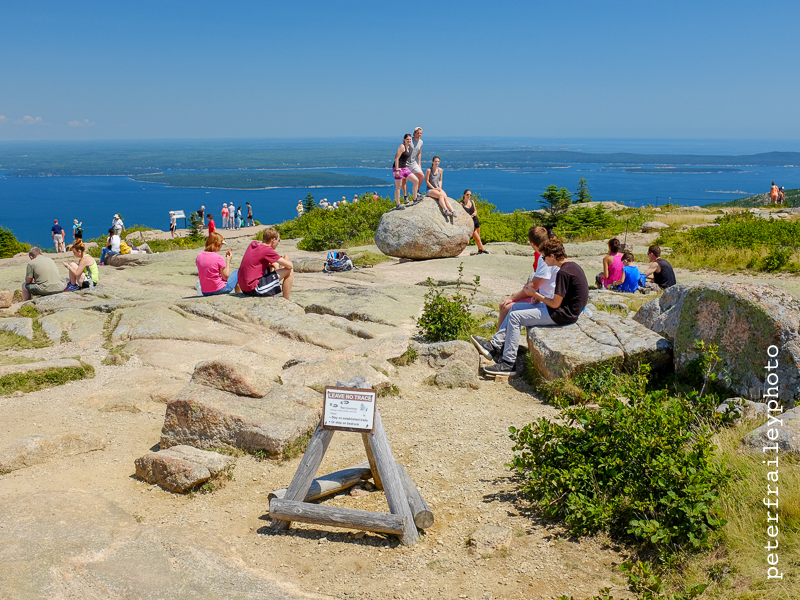
My friend Dennis commented on the Cadillac Mountain photos included in my last post. He liked the image below, which is presented here pretty much the way I processed it seven years ago in whatever version of Lightroom was then available.


Dennis has a good eye and photographic vision, and he made some processing suggestions that I found worth experimenting with.  The changes, all done in the current version of Lightroom Classic, make this image quite a bit more dramatic.

Based on Dennis' recommendations, in Lightroom I increased the contrast (+41), increased the clarity (+100), and added a slight vignette to darken the corners.  I also warmed the white balance temperature by changing it from 5,100 to 6,500 degrees kelvin.  Instant drama!

[Check out Dennis Mook's blog, especially if you are an Olympus or Fuji user, as Dennis shoots with both systems, with one or more Panasonic lenses thrown in for good measure. Link: https://www.thewanderinglensman.com ]

"Visitors at Cadillac Mountain"
Panasonic G2 with Olympus 14-54mm
 @43mm (86mm-e)
F7.1
ISO 100
1/800 sec


11.02.2018

Clear Views atop Cadillac on Mt. Desert Island

My last post, in which I featured a few photos from the top of Cadillac Mountain on Mount Desert Island on a foggy day this October, had me thinking about all the times I’ve been up there when the views were clear. Because today is a rainy, windy and cold Saturday, I decided to go into my archives (i.e. my lightroom catalog) to find a few images from prior years.  

What I noticed is that I have no images taken during the golden hour.  The last time I was there at sunrise was some 20 years ago with a film camera, and I don't know where any of the photos (if any) are.  And I have never been there during sunset.  So, all of these were taken during the challenging conditions of mid-day. 

Here are a few:


The town of Bar Harbor. Cruise ships are a growing occurrence.
The islands are known as the Porcupine Islands, due to their shape and appearance.


10.28.2018

Fog, Mist, and Clouds atop Cadillac Mountain


Cadillac Mountain on Mt. Desert Island, Maine is not a big mountain.  In fact it is only 1,530 feet high.  But the views are terrific.  From the top you have more than 180 degrees of ocean and harbor views, and you can see for miles... on a clear day.

Due to it’s height and longitude and latitude, many argue that it is the first place in the United States where you can see the sunrise. But others argue that Mt. Katahdin at 5,600 feet, but further inland, deserves that honor.


Access to the top of Cadillac is easy via a winding road that opened first in 1931 (and clearly has been maintained and improved since then).  The road terminates at a parking lot that is often full at mid-day.  Unfortunately, even during an early summer sunrise, this means a traffic jam of people, especially in recent years.  

I have never been there at sunset, but I understand that that too is spectacular. There are at least two hiking trails leading to the top. My favorite starts at the Black Woods Campground.  

Lichen on the Granite Boulders

As beautiful as it can be atop Cadillac, Maine weather is unpredictable.  And along the immediate coast there can be fog and a cold mist, even while a few miles inland it might be bright and sunny and warm.  That’s what this day was all about!

Winter Berries

On this day I felt sorry for visitors who were hoping for a nice scenic view.  But the top half of the mountain was in a cloud, and it was cool and windy and misty-wet.  Many visitors had their camera slung over their shoulders but few were taking pictures.  I saw a few selfies being taken, all with fog for a background.


Because I didn’t want to go away without a few pictures, I gave up on the “big scenic iconic shots” and focused my attention on more intimate pieces of the landscape, as shown in the four images above. 

10.23.2018

One Photo: Fall Blueberry Barren in Maine


Seen here is a tract of managed blueberry barrens.  Soil here is naturally nutrient-poor and acidic. Apparently this is perfect for blueberries, though since this field is harvested commercially, I am guessing that some fertilizer is added to the mix. 

Barrens are wide open areas that are flat or hummocky and covered with dwarf shrubs, like these lowbush blueberries. There are also often “carpets” of reindeer lichen, though I don’t see any from this angle.


"Fall Blueberry Barren"
Blue Hill, Maine
Olympus E-M1 and 12-100mm F4 zoom @ 54mm
Auto ISO 200, Aperture priority F8, 1/125 sec
Processed in Lightroom Classic CC


What is particularly remarkable is that these lowbush shrubs (which are green and of course “chock full” of blueberries in the summer) have some of the first leaves to turn color in fall. And this is a bright red and/or orange!  Unfortunately, summer travelers in Maine never get to see this spectacular fall display.

[These barrens are owned by a friend of mine.  Last summer we picked berries along the edge of this road.  My wife and I picked a couple of quarts each, in just minutes.]


10.08.2018

Focus Stacking a few September Flowers

During my one visit to the botanic garden in September I found myself rather disappointed.  Everything was beginning to look a bit ragged. I was nevertheless pleased with these images.
These flowers were photo stacked with between 5 and 12 images.  Whoops, the first one is a wild geranium and it is a single shot.

The lens used is an Olympus 12-100 (24-200mm equiv) F4 zoom.  The camera is my aging Olympus E-M1.  All were done at base ISO 200 and aperture was wide open at F4. All were hand held. Shutter speeds ranged from 1/250 to 1/640. Images were merged and edited in Lightroom Classic.

Wild Geranium (one image)

Phlox (12 images)

Verbana (5 images)

Marigold (9 images)

Anenome (10 images)

9.24.2018

Reflections: To Polarize or Not


Based on what I have read, a polarizer is a “must have” filter when near water or when the sky is blue and filled with puffy clouds.  Or, at least that has been my “take away” when reading various articles by the experts.  Near water and other reflective surfaces (automobiles and foliage, for example) the polarizer cuts the reflections.  And when it comes to blue sky and clouds, the filter can brighten the blue and keep details in the white clouds.

In the two examples below, the polarizer was able to simplify the composition in photo #1 but cutting out the reflections being created by the surrounding vegetation.  

But just because you have a polarizer in the camera bag doesn’t mean it must be used!  I actually find them to be cumbersome to use, as the more times you screw one on and screw one off, the more likely it is that you will drop it or at the very least smudge it or the lens. In the situation below it would mean potentially dropping the polarizer in the water, so I didn’t bother with it in photo #2.

These two images are very different.  I don’t know which I like better, but my current favorite is photo #2.  That’s because it seems kind of artsy and abstract.  I guess any time a photo makes me feel like an actual artist, I like it.  YMMV.

Photo #1: With Polarizer

Photo #2: Without Polarizer


9.17.2018

1958 Jaguar XK150 3.8L Red Convertible Coupe

This 1958 Jaguar two-seater coupe was the first thing I keyed in on at a recent "British Car Day" at Larz Anderson Auto Museum.  It would have been impossible to miss this beautiful red sports car.  And red is so photogenic.

Here are the photos I took as I strolled around the Jaguar.


9.10.2018

Visiting Bailey Island, Maine

[Photos taken on three days in July 2016, December 2017, and July 2018]

When in Maine (along Maine’s “mid-coast”) we frequently drive south from Brunswick to explore many of the little fingers of land that protrude into the Atlantic Ocean, more specifically into Casco Bay.  One such “finger” is made up of two islands that are attached by bridges.  The first is Orr’s Island and the second is Bailey Island.

This photo was taken at the end of Orr's Island, just before
the Bailey Island Bridge

H2O Outfitters.  On Orr's Island, next to the bridge


The bridge that connects Orr’s to Bailey was built in 1928.  It is called simply Bailey Island Bridge; but it is far from a simple bridge.  It is what is know as a cobweb or cribstone bridge, and is said to be the only such bridge in the world. It is made with slabs of local (Yarmouth, Maine) granite.  The unique design of laying the slabs in a stacked and criss-cross pattern gives support while at the same time allowing tides to rush through the entire 1,150 foot length of the bridge. I have read that 10,000 tons of granite were used in the construction.

The four photos below were taken from the property of Cook’s Lobster House. In the first two images you can see the Bailey Island Bridge in the background, with the granite slabs stacked like Lincoln Logs.


Two popular photo opportunities I have found are (1) The Nubble, a bait house adorned with lobster buoys, and 

The Nubble

(2) Mackerel Cove.  We’ve enjoyed picnic lunches at Mackerel Cove in a small park next to the water.  However, as nice as a picnic can be, it is sometimes difficult to pass up Cook’s Lobster House where the fish and lobster cannot be any fresher.


At the very end of the island the road comes to a dead end at a large gift shop and parking lot.  It’s a nice place to walk along the rocks and see the view.  This bronze statue, called The Lobsterman, is a replica of one created for the 1939 New York Worlds Fair.  There are several replicas elsewhere, and I have seen one in Portland, Maine.