Showing posts with label dynamic range. Show all posts

7.27.2012

Olympus E-M5 Post #11: Dynamic Range Part 5

A while ago I tested the Panasonic GH2 and the Olympus E-M5 to see if I could see a difference in the dynamic range of the camera.  In the last test I did I determined that when it came to the shadows I really couldn't tell the difference.  But from what I've read, there should be a noticeable difference in the highlights.

So, I decided to check this out on my own.

I shot the scene in the images below in P-mode with my reg43 14-54II zoomed out at 14mm on both cameras.  To simulate a high dynamic range situation,  I shot (1) a base case, (2) 1-stop overexposed, and (3) 2-stops overexposed.  I didn't care that the F-stops and shutter speeds chosen by each camera were different.  I simply shot the way I would in the field when shooting landscapes, using the live histogram to guide my exposure settings, but adding 5-shot auto exposure bracketing to get the two overexposed shots.  All images were taken in raw.

Base Images

Below are the base images, after tweaking in Lightroom 4.  The tweaking meant adjusting the highlights and white sliders to get a better (i.e. darker) exposure in the clouds and sky, and adjusting the shadows slider to get a better (i.e. brighter) exposure in the dark areas.

My usual Lightroom slider settings for landscapes are:

highlights = -50
shadows = +50
whites = -50

Oly on left, Pany on right.  Shooting the Pany at 3:2 aspect ratio was an error.  Both pictures were taken
in the camera's P-mode in RAW, with adjustment to highlights, white point, and shadows done in Lightroom 4.
I don't see any dynamic range differences in my final images, at the base exposure setting.


Overexpose by 1-stop

The next set of comparative images are shots taken with 1 stop more light.  No Lightroom adjustments were made to this next set of images.  Both images just barely kept all the pixels within the histogram range.  The clouds look bright, but they are not blown out. There is detail throughout.  At 1-stop overexposure the sensors on both cameras are reaching their limits, it would appear.


The next two images show what can be done in post-processing to improve these two images.  Highlights were pulled back and shadows opened up using the the highlights, whites and shadows sliders in Lightroom 4, to create very satisfactory images. The Olympus images seems to show more "haze" in the sky; but I am guessing most of that is due to changes in the sky during a short time delay as I switched lenses on the two cameras.

Bottom line: I am happy with both of these images, though I think highlights are getting close to being clipped on the Panasonic image.


Overexposed by 2-stops

At 2-stops of overexposure, the sky seems blown out on both.  Neither of the two images below seem particularly great and I thought there'd be no way I could recover any highlights in Lightroom 4.


But I was entirely shocked (and excited) when I set to work with the highlight, whites, and shadows sliders in Lightroom 4.  Look how great the recovery was with the Olympus image, below left. The Panasonic image, on the other hand is beyond repair.


Conclusion

I'm not going to sell my GH2 because of this.  (Actually, I will probably sell it when the GH3 comes out.)

I need to be practical when comparing the GH2 and E-M5.  I have 350 images from each camera from a two week trip to the Canadian Rockies.  I don't have even one example where I ran out of headroom and footroom in post-processing.  And I never had an accidental exposure where I needed to recover two stops of highlights like the examples above. I should point out that this experience was with many landscape scenes with dark pine forests and snow capped mountains. 

Having said that, this does show that there can be (IMHO) an advantage to using the histogram to add a bit of positive EV compensation.  Sometimes this is called ETTR (exposing to the right).  In so doing, you can add exposure to the dark areas before post-processing. And then, to bring back color in the sky you can pull back a bit with the Lightroom sliders that effect highlights and the white point.

With Lightroom 4 I am finding the following setting to be a good starting point for almost all of my  travel and landscape pictures:

highlights = -50
shadows = +50
whites = -50
blacks = adjust to taste and to get more/less contrast

I know there is a clamouring for more dynamic range.  I read about it in all the online forums. But I don't know how much more we really need.  I am very happy with what I have now.

In the next generation of sensors, I'd gladly give up any additional dynamic range in exchange for lower ISO's like 100, 80 or 50.

5.11.2012

Olympus E-M5: Post #9: Dynamic Range Part 4

If there is a dynamic range difference between the two year old Panasonic GH2 and the new Olympus E-M5, I can't see it in the shadows.  Since tests by dpreview show that there actually is a difference, with the Olympus seeming to have 2/3 of a stop more dynamic range in the shadows, I am wondering if testing devices are so good these days that they can see nuances that escape the human eye!  Or, maybe I need to do some testing at higher ISOs.

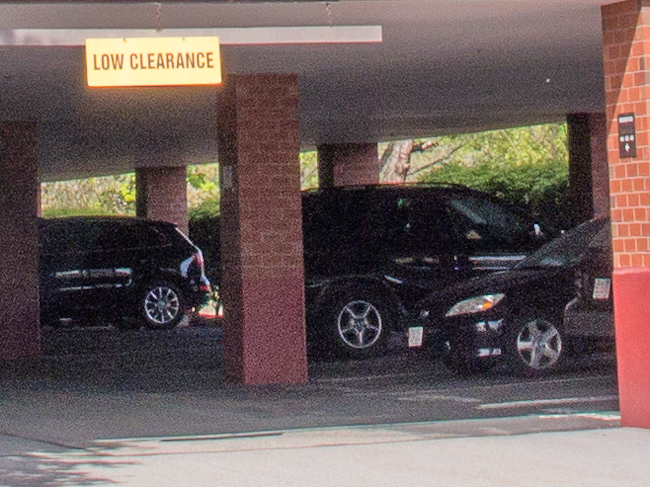
Below are two images taken with the same lens, switching between cameras on a bright sunlit day with deep shadows in the parking area under this office building.

Both images were developed from RAW with default settings in Lightroom 4, except white balance.  I equalized the white balance settings at the daylight setting of 5500 degrees Kelvin.  Interestingly, the Panasonic metered at 4950 degrees and the Olympus at 5250 degrees. This was in spite of the fact that I have made no white balance adjustments in the cameras

If you see a difference with respect to dynamic range, between the Oly and the Pany, your eyes are better than mine.  Perhaps I see slightly more detail in the Oly in the 100% crops, but is that just because I know there is "supposed" to be?

In each of the following pairs of images, Olympus is first, Panasonic is second.  Larger images are on my Web site, here:
http://www.peterfraileyphoto.com/olympus-em5-dynamic-range-pt4


Olympus 1/250th F8 iso200 14mm (14-54II)

Panasonic 1/250th F9 iso160 14mm (14-54II)
100% crop of Olympus image, of parking area entrance under the building
100% crop of Panasonic image, of parking area entrance under the building

Olympus at 100% crop. Shadow slider at 100% to open the dark area under the garage.

Panasonic at 100% crop.  Shadow slider at 100% to open the dark area under the garage.

Conclusion

[Edited July 25, 2012]

As I mentioned in the opening paragraphs, based Based on these images I can't see (any practical) tell the difference in dynamic range (or image quality for  that matter) between the two year old GH2 and the new E-M5.  And that is after looking at 100% crops and trashing the image by running the shadow slider to 100%.  As far as I am concerned both cameras have fantastic image quality.


But
But, on the other hand I haven't checked out the highlights.  I intend to take a couple of comparative images with blown highlights at various overexposures to see which camera is able to recover details better in blown exposures.  This will be a topic for another day and for another post.

5.09.2012

Olympus E-M5: Post #8: Dynamic Range Part 3

I received an email about the last couple of posts.  Seems my conclusion that the dynamic range of the E-M5 and GH2 is similar is contrary to what's being published on the Internet.  According to many users and reviews it is claimed that the dynamic range of the E-M5 is higher than the GH2.

That may be true and I hope it is!  But, actually what I posted in the prior two posts was that in the one shot in which I compared the two cameras the dynamic range was similar.  Assuming for the moment that the dynamic range of the E-M5 is greater than the GH2, the reason that they seemed similar in my example is because the sensors were not being stressed enough to show a difference.  I plan to try the experiment on some images in more challenging situations, although my guess is that in the "real world" the difference will not really make a difference.

With regard to the images I used in the prior two posts, examining the histograms shows that though there were bright areas (clouds) and dark areas (pine trees) in the scene, that this was all handled nicely by the sensors.  As you can see below, the histograms are pretty normal (and very similar), with few pixels on the black and white ends of the spectrum.  There were no "blown out" highlights and no "blacked out" shadows.

Olympus E-M5 histogram of original image in prior post

Panasonic GH2 histogram of original image in prior post
I'm working on another sample in which I have definitely created a dark scene within a relatively bright scene.  The dark areas will come from a parking lot under my office building. It will be the subject of my next post.

5.08.2012

Olympus E-M5: Post #7: Dynamic Range Part 2

For this post, I have taken yesterday's two images (see prior post) which were processed from RAW files at default settings in Lightroom 4 and today I "opened" the shadows using the Shadows Slider in Lightroom.  I moved the sliders all the way to the right, to 100%. In this way I "engineered" more dynamic range.

The first two images are the "before" and "after" shots from the Panasonic GH2 and the second two images are the "before" and "after" from the Olympus E-M5.

Panasonic GH2 before and after shadow slider adjustment


Olympus E-M5 before and after shadow slider adjustment


My Conclusion


Clearly there is a difference between the before and after shots. But when it comes to comparing the two "before" shots to each other, and the two "after" shots to each other, I don't see any meaningful differences. I would have to conclude, at least for this scene, that the dynamic range of the two sensors is the same. That is, both captured details in the highlights and the shadows equally.

Off topic:  I do feel that panasonic images have a bit more magenta in them, as seen in the black macadam driveway.


Larger files of the four images can be found here:
http://www.peterfraileyphoto.com/em5dr2

5.07.2012

Olympus E-M5: Post #6: Dynamic Range Part 1

Much of what I have read tells me that the dynamic range of this new Olympus has improved over other recent Olympus m43 offerings.  This may be true, but the only m43 format camera I have to compare it with is the flagship of the Panasonic line, the GH2.

Dynamic range refers to the camera's ability to provide decent detail in both the brightest and the darkest areas of a picture.  After all, when you take a picture, the camera provides only one exposure and it is usually an average based on light tones, mid tones and dark tones.  Mid tones might be exposed perfectly but light tones might be overexposed and dark tones underexposed.  The less the dynamic range, the more likely this will be the case.  And of course it is especially noticeable in images where there are both lots of bright areas and lots of dark areas.

Today, I compared the GH2 and E-M5 with a couple of pictures that had both bright areas (white clouds) and dark areas (shadows in the trees).  As it turns out, neither camera was stressed by these conditions and both did a very nice job providing details in the clouds and sky while at the same time not being too dark in the shadows.  Of course, the human eye would be able to see more deeply into the shadows than this, but a camera's sensor does not have the dynamic range of the human eye.

As far as I can tell, if there is a difference, it doesn't make a difference. These both look good to me, and quite similar.

However, I will try to find a more rigorous test.  This will require a scene with even more contrast, with brighter brights and darker darks.

These two images are jpegs created from raw files in Lightroom 4.  The lens was the Olympus 14-54II.  Both were shot and 1/125th and F11.  I used P-mode and autoISO.  Both cameras set ISO at base levels of 160 (Pany) and 200 (Oly).  In Lightroom I set WB at 5500 Kelvin.  I used "Auto Tone" to equalize the exposure, contrast, and saturation settings.  I used Lightroom's default sharpening settings.

If you want to see bigger files, they're here:

http://www.peterfraileyphoto.com/em5dr

Panasonic GH2 with Olympus 14-54II.  A bit more magenta than Olympus even
at the same WB setting. Note the "purple-ish" color cast in
the driveway asphalt.  But the dynamic range seems the same as the Olympus
(see below).

Olympus E-M5 with 14-54II. Dynamic range seems to be equal to the Panasonic.  To me, both look good.


Conclusion:  As far as I can tell in these two shots the dynamic range is the same.  I do like the color profile of the Olympus shot.  It doesn't have the purple color cast that I see in the Panasonic file.  A tweak here or there in Lightroom might get rid of that. Noise and sharpness seems identical.

The next step with these images it to see if one file is easier than the other to bring up (i.e. lighten) the shadows, as the shadows here are darker than what my eyes saw.  In other words, perhaps we can "engineer" more dynamic range better from one than the other.