Showing posts with label olympus 12-100. Show all posts

12.23.2018

Inside at the botanic garden in November

Below is a set of images from the Tower Hill Botanic Garden, from a visit in November.  All were shot with an Olympus E-M1 and either the Olympus 12-100mm F4 zoom or the Olympus 60mm F2.8 macro lens.  All were shot at F4 and at a range of ISOs, depending on the amount and direction of light.

All were focus-bracketed with between 10 and 18 images and the camera was hand-held in all cases.  Processing was in Lightroom, and aligning the images and stacking was completed in Photoshop.

Cape Fuschia
10 focus-stacked images
Olympus 12-100mm

Indian Mallow
15 focus-stacked images
Olympus 60mm macro

Rosemary
17 focus-stacked images
Olympus 60mm macro

Forked Blue Curl
13 focus-stacked images
Olympus 12-100mm

Bougainvillea
9 focus-stacked images
Olympus 12-100mm


Croton
16 focus-stacked images
Olympus 12-100mm

Match Stick Flower
18 focus-stacked images
Olympus 12-100mm

Palm Frond
17 focus-stacked images
Olympus 12-100mm

11.11.2018

One Photo: Fall Damselfly

Last month while vacationing in Maine, on a day that was not so pleasant for landscape photography, I decided to look a little "smaller".  I saw a patch of ferns that were turning their rusty brown dying fall colors and I thought I might find a nice composition.  What a thrill it was to get my lens lined up and to see this damselfly perched on a dead fern frond.

Both dragonflies and damselflies pose very nicely.  In fact, if you do disturb them and they fly off, they will often come right back to the same spot.  I've experienced that many times.

Do you know the difference between a damselfly and a dragonfly?

Answer:

A damselfly rests with its wings straight back.  A dragonfly rests with its wings outstretched at a 90 degree angle from its body.


"Damselfly on Fern"

Olympus E-M1 with 12-100 F4 zoom @ 100mm (200mm equivalent)
Aperture Priority at F4.  Auto ISO 200.  1/500 sec
Processed in Lightroom Classic CC


8.27.2018

Photography can be a bit like Fly Fishing. Really.


I decided to visit our local botanic garden for a few hours last weekend.  The sky was a bit hazy which makes for nice diffused light (though it did unfortunately clear up somewhat once I got there), and the wind was light. The air temperature was delightfully in the 70s and the humidity was not quite at the “uncomfortable” level.  It was quite an enjoyable visit, with lots of happy people walking around, including many kids on what seemed to be a scavenger hunt. 


We’ve had a lot of heat this summer and recently some very heavy rain.  The result of this is that the flowers during this visit generally looked a little beaten up. But I was able to shift gears to the insect life.  I’m not a huge fan of getting close to bees, but with my 12-100mm Olympus lens (24-200mm equivalent)  I felt I could shoot from a safe distance.  Plus I think the bees were a lot more interested in the flowers than in me!  The long zoom also helped with the butterfly photo.  Had I brought two cameras I would have put my Olympus 60mm macro on the second camera, as I would have liked to have been closer to the spider.


It was not until I got back home and viewed my 300+ images, and found a mere 9 that I thought were “good”, that I began comparing my outing at the botanic garden with fly fishing.


Think of the 300 shutter actuations I made, as I walked among the flowers, as similar to perhaps 300 casts with my fly rod, as I walked up and down the river.  Then think of the 300 captures (i.e. photos) as similar to a pile of caught fish, or at least bites or nibbles.  (Actually, 300 fish - one on every cast - is unlikely).  The 9 good images are like 9 good-sized fish, the other 294 fish being thrown back into the river, and the other 294 images being deleted.  What you see in this blog post are those 9 photos.


There are plenty of other similarities.  Both activities provide recreation by offering an opportunity to get outdoors and to be in nature.  The camera is similar to the fly rod and reel… all being nice pieces of modern technology, designed to capture the subject of your adventure.  The camera backpack with assorted lenses and accessories is like the fly fishing vest full of flies and accessories.  Perhaps, too, the art of post processing one’s images can be compared to the art of tying one’s own flies.


Enough said about fly fishing.

The image below is my favorite image of the set.  It is the crab spider I mentioned above. Using my fishing analogy, this would be the biggest trout of the outing.  What I like so much about this photo is the nature story.  And actually, I saw this capture happen.  

I was looking down on the flower and saw the fly about to land.  I heard a snap as the "claws" of the spider snapped shut on the fly.  As far as I can tell there are no webs for the crab spider to catch his prey.  Instead he patiently awaits for a fly to come within his range.  The two most-forward legs on each side are held wide open like a crab with claws. Each pair of legs appear to be glued together, making it look like there are only two claws, one on each side.  (Though the spider is no longer "in wait", you can see that his left forward two legs are held together.) These legs/claws snapped shut as fast as one of those spring-loaded mouse traps, and instantaneously pulled the fly into the spider's mouth.


6.14.2018

I Tested a few of my m43 Zoom Lenses


A couple of weekends ago I had to come up with a “plan C” for Saturday morning.  Plan A was to go fly fishing, but with winds in the 10-15 mph range this would not have been wise.  The wind makes casting a fly quite difficult and you never know when the fly will end up in the back of your head.  

I also had to nix Plan B.  That was to go to the local botanic garden and look for flowers to  photograph. As you would imagine, a windy day makes it quite difficult to photograph flowers outdoors. 

I had to come up with Plan C.

The view from Gibbet Hill.
Panasonic 35-100 F4-F5.6 @ 35mm (70mm equivalent)

Plan C became a walk along some paths in Groton with a stop at the top of Gibbet Hill with a tripod, Olympus E-M1, and several zoom lenses. The view was beautiful and I had a nice time “playing around” with these lenses. I was curious about relative sharpness, and the church in the background gave me something distant to focus each lens on. I had my Olympus 12-100 F4 (highest quality), Panasonic 100-300 F4-F5.6 (consumer quality), Panasonic 45-175 F4-F5.6 (consumer quality), and Panasonic 35-100 F4-F5.6 (the miniature and consumer quality kit version). 

Note that Olympus and Panasonic have 2x crop factor sensors.  To obtain the equivalent focal length one must multiple by 2x.  For example, the 12-100mm has an equivalent focal length of 24-200mm.

I believed that the 12-100 is “more than good/sharp enough” and that the other three are “good/sharp enough” for my use.  The results of my experimentation atop Gibbet Hill confirmed this. 

Left to right in order of sharpness: 
Olympus 12-100, Panasonic 100-300, Panasonic 45-175, and Panasonic 35-100

I used these focal lengths:

  • 35mm
  • 45mm
  • 75mm
  • 100mm
  • 125mm (two Panasonics only)
  • 175mm (two Panasonics only)

I used these apertures:

  • F4 
  • F5.6 
  • F8
What I found out was not surprising.  It was just as you might expect.  The bigger and more expensive the lens, the better it performed (in this test, on a tripod, on an Olympus body)… except that the 12-100 is slightly shorter than the 100-300, though heavier and twice the price.

Results:

  • The 12-100 is sharper across the frame than the three below (except equal to the 100-300 at 100mm)
  • The 100-300 is sharper across the frame than the two below
  • The 45-175 is sharper across the frame than the one below
  • The 35-100 is the least sharp (but still sharp enough in my view)

I don’t think I would notice the difference in the three Panasonic lenses over their common focal lengths, except that I examined them at 1:1 and side-by-side in Lightroom. Going forward, I feel equally comfortable with any of these three Panasonic zooms.  It would just be a matter of what my use for them would be.  

The 12-100 is my default lens.  That is a given.  It is a superb lens and 90% of my images since purchasing it when it was introduced have been with this lens.

I would add the 100-300 to my bag if I were visiting Yellowstone again, as I used it for large animal images last summer.  I also used it along the Maine coast because I can zoom into operating lobster boats and schooners in Penobscot Bay.  

Without the animals and the boats, the 45-175 is an adequate and smaller/lighter solution.  It is compact too, as the zoom is completely internal.  

Finally, the 35-100 is very small and matches and balances nicely with my 12-32 and the diminutive Panasonic GM5 camera. That’s a nice package for hiking or bicycling, or any situation where photography is not your main mission but you want something better than a cell phone.

I should note that while on the tripod for this experiment, image stabilization was off.  It may be that my results would be different if I had hand-held the camera instead and used image stabilization.  Perhaps that will be an experiment for another day on top of Gibbet Hill.


2.03.2018

A Few Flowers from the Tower Hill Botanic Garden


I found a couple of hours Sunday to take a trip to the local botanic garden. It’s called Tower Hill Botanic Garden. 

I made my trip simple by taking one camera and one lens, the EM-1 and 12-100mm F4 zoom. These images were taken at various focal lengths, at either F4 or F8. The focus bracketing and stacking feature might have helped; but again, I wanted to keep things simple. Purposely, I left the tripod at home.

[Had I remembered at the time that my Panasonic GX80/85 has a feature called “aperture bracketing”, I might have grabbed that body instead. With one press of the shutter you can get several or even all F stops. Next time!]

For each composition I shot one image at F4 and one at F8, not knowing which I’d prefer until I got back to my computer.  It’s always a compromise. Choose F4 and get a blurry-ish background that reduces distractions, or choose F8 and get more of the subject in focus due to greater depth of field. 

Native aspect ratio is 4:3 with Olympus (and Panasonic) cameras, but all of these have been cropped to a more square aspect ratio of 5:4 (as is found with a 8” x 10” print.)

Five F4 images:


Abutilon
100mm 1/250sec 800ISO

100mm 1/250sec 500ISO

50mm 1/100sec 500ISO

100mm 1/250sec 200ISO


Five F8 images:

Orchid
100mm 1/200sec 800ISO

"Ouch"
100mm 1/200sec 1000ISO

100mm 1/200 ISO3200

100mm 1/250sec 3200ISO

Camellia
100mm 1/200 2500ISO


1.25.2018

My First Year with the Olympus 12-100mm F4 PRO Zoom | Part 2 of 2


Part 1 was about size and weight and one comment about sharpness....

Part 2 is about features and handling....


In my opinion the most wonderful thing about this lens is its flexibility.  This is not just because of the wide range of focal lengths, but the fact that you can fill the frame at essentially all focal lengths (not at 12mm, but at 14-100mm) with a flower that measures 3” across.  This lens has well for for me, for flower and food photography.  I have owned the Olympus 60mm macro lens since its introduction, but now hardly need it for flowers and food. 

@70mm

@100mm

@34mm

@100mm

@100mm

Though there are times I’d prefer the option for a shallower depth of field for people photography, I nevertheless enjoy the no-brainer ease of just shooting wide open at F4.  For me that is usually candidly photographing family.


@57mm

@100mm

The 12-100 is all I need for car photography, which I have enjoyed a few Saturdays during the summer on the lawn of the Larz Anderson museum near Boston. Again, I typically shoot wide open. 


@100mm

@25mm

@100mm

@21mm

But most of my images are landscape and travel images. The lens has been perfect for that, as I hate changing lenses. Even if the 12-100 were glued to the EM-1, and therefore I had no other choices, I think I’d be happy.  

@12mm

@60mm

@29mm

@28mm

@20mm

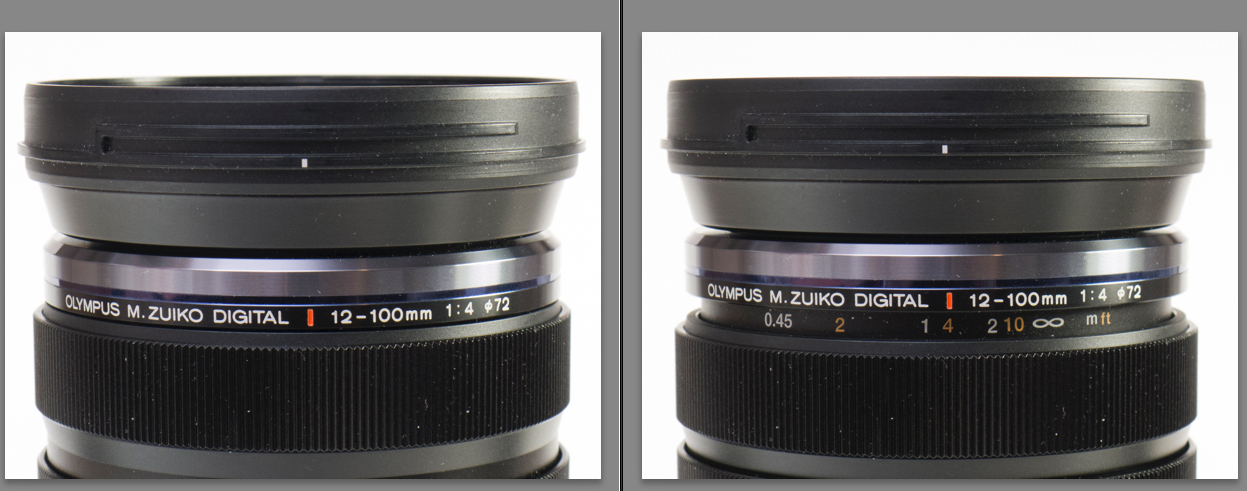
I also like the physical and ergonomic aspect of the lens.  It has a “snap back” or "clutch" focus ring which changes the focus ring from a fly-by-wire focusing system to what feels like a mechanic focus ring with hard stops at both ends of the focus range.

Fly by wire focusing available on the left.
But notice on the right that the focus ring has been pulled down
to reveal a distance scale with hard stops at both ends of the scale.

I like that the rings (focus and zoom) are metal, not rubber.  They do not show wear, which I think will be helpful when (or if) I ever sell the lens.


Metal focus and zoom rings.

Switching the image stabilization off when using a tripod is easy as there is a switch on the lens barrel. And finally, there is the L-Fn function button on the lens barrel next to the image stabilization switch. Because the EM-1 body has only the one AFL/AEL button, one option is to set it for AEL and use the function button on the lens to lock focus.


On/off switch for image stabilization and an additional function button.


I have found only one downside, and that is the 72mm filter size. This is my problem, not the problem of the lens, because unfortunately my largest filters were only 67mm.  Looking back, of course I should have done what so many have recommended. I should have bought 72mm filters (or even the next size bigger!) from the very beginning. Then just spend a few dollars to get a set of step up rings.  Oh, well. Live and learn. 


My Instagram Feed is https://www.instagram.com/peterfraileyphoto/

My Photography Website is https://peterfraileyphoto.com/


1.21.2018

My First Year with the Olympus 12-100mm F4 PRO Zoom | Part 1 of 2


Part 1 is about size and weight and one line about sharpness ....

The Olympus 12-100mm (24-200mm equivalent focal length) has been a well-used and well-loved lens for me this past year.  I see that it has even relegated my Panasonic 14-140, a favorite from the prior year, to my lens drawer. Though the 14-140 is a “sharp enough” lens, the 12-100 is “more than sharp enough” and importantly has a few additional features, albeit at a significantly higher (2x) price point. 

Most of the 12-100’s use last year (90%) was on the Olympus E-M1 which I have owned since it was first introduced some four years ago, and 10% of its use was on the Panasonic GX80/85, a camera that I acquired last summer. Both are 16mp cameras and I can't tell the difference in image quality with this lens, though I have to say that the lens balances better on the E-M1.


I did some filtering of images using Lightroom and found that last year I have saved about 2,000 images. I am sure my shutter actuations were more than twice that; maybe as high as 10,000, if past years' shutter counts are any indication. 

What I found is that 50% of my images last year were taken with this lens.  This is a very high percentage because I have multiple lenses, many of which cover the same focal width.  For example, my next most used lens was the Olympus 12-40 F2.8 PRO at 10%.  Overall, it seems there were very few images that could not have been made with the 12-100.

Some reviewers have complained (or listed as a “con”) that the lens is big and heavy for a m43 lens. Of course, that is a subjective conclusion.  I feel it balances well with the Olympus E-M1.  With the added RSS L-plate/grip, the total weight of the camera and lens is 2.6 pounds.  

2.6 pounds

This body and lens package is lighter than just the lenses would be for a full frame Canon shooter (the required two lenses to cover the equivalent focal range would total 3 pounds) or Sony shooter (lenses would total 2.8 pounds), data for which is in the bulleted sentences below. 

I smile when I think of how small and light this one m43 lens is compared to the full frame duo of a 24-70 F4 and 70-200 F4.  Yes, I do realize that it is not an apples-to-apples comparison because the depth of field is shallower with the full frame gear.  On the other hand, if you are mostly a landscape photographer who might shoot a scene with a full frame camera at, say, F16, you will only need F8 with m43 to get the same depth of field, assuming the same equivalent focal length and the same focusing distance.  Depending on the light available, this might be an advantage for the m43 system by allowing lower ISOs. 

Here are some comparisons (data from imaging-resouces.com):
  • In the Sony full frame FE mount, a 24-70 F4 plus 70-200 F4 combo would set you back about $2,700 and weigh 2.8 pounds.  Neither lens has much of a macro feature (1:5 and 1:7.7 respectively). Both have lens based image stabilization. The larger of the two lenses is 7” long.

  • In the Canon full frame mount, a 24-70 F4 plus 70-200 F4 combo with image stabilization would be cheaper than the Sony option and would set you back $2,050 and weigh 3.0 pounds. The 24-70 has a nice macro (1:1.4) but the 70-200 does not (1:4.8).  The larger of the two lenses is 6.8” long.

  • Now let’s look at the Olympus 12-100 (24-200mm equivalent all rolled into one). Image stabilization is a bit complicated.  Olympus cameras have in-body stabilization, as do now several of the Panasonic bodies.  In addition, a few of their longer lenses, including this one, have optical stabilization which works together with in-body stabilization on, at least, the E-M1 mark 2.  Regardless of how the two types of image stabilization work on my E-M1 (first version), I find the stabilization to be spectacular, and I am guessing that many would view it to be superior to what is on the Canon and Sony lenses mentioned above.  This lens will set you back $1,300 and weighs 1.2 pounds.  Macro is superb: 1:1.6 at wide angle and 1:2.3 at the long end (full frame equivalent). The length of the lens is 4.6”.

It is these comparisons that cause me to dismiss arguments that this "large" lens defeats the purpose of the micro four thirds format.


Part 2 will be about features and handling ....


My Photography Website is https://peterfraileyphoto.com/