Showing posts with label panasonic 35-100. Show all posts

6.14.2018

I Tested a few of my m43 Zoom Lenses


A couple of weekends ago I had to come up with a “plan C” for Saturday morning.  Plan A was to go fly fishing, but with winds in the 10-15 mph range this would not have been wise.  The wind makes casting a fly quite difficult and you never know when the fly will end up in the back of your head.  

I also had to nix Plan B.  That was to go to the local botanic garden and look for flowers to  photograph. As you would imagine, a windy day makes it quite difficult to photograph flowers outdoors. 

I had to come up with Plan C.

The view from Gibbet Hill.
Panasonic 35-100 F4-F5.6 @ 35mm (70mm equivalent)

Plan C became a walk along some paths in Groton with a stop at the top of Gibbet Hill with a tripod, Olympus E-M1, and several zoom lenses. The view was beautiful and I had a nice time “playing around” with these lenses. I was curious about relative sharpness, and the church in the background gave me something distant to focus each lens on. I had my Olympus 12-100 F4 (highest quality), Panasonic 100-300 F4-F5.6 (consumer quality), Panasonic 45-175 F4-F5.6 (consumer quality), and Panasonic 35-100 F4-F5.6 (the miniature and consumer quality kit version). 

Note that Olympus and Panasonic have 2x crop factor sensors.  To obtain the equivalent focal length one must multiple by 2x.  For example, the 12-100mm has an equivalent focal length of 24-200mm.

I believed that the 12-100 is “more than good/sharp enough” and that the other three are “good/sharp enough” for my use.  The results of my experimentation atop Gibbet Hill confirmed this. 

Left to right in order of sharpness: 
Olympus 12-100, Panasonic 100-300, Panasonic 45-175, and Panasonic 35-100

I used these focal lengths:

  • 35mm
  • 45mm
  • 75mm
  • 100mm
  • 125mm (two Panasonics only)
  • 175mm (two Panasonics only)

I used these apertures:

  • F4 
  • F5.6 
  • F8
What I found out was not surprising.  It was just as you might expect.  The bigger and more expensive the lens, the better it performed (in this test, on a tripod, on an Olympus body)… except that the 12-100 is slightly shorter than the 100-300, though heavier and twice the price.

Results:

  • The 12-100 is sharper across the frame than the three below (except equal to the 100-300 at 100mm)
  • The 100-300 is sharper across the frame than the two below
  • The 45-175 is sharper across the frame than the one below
  • The 35-100 is the least sharp (but still sharp enough in my view)

I don’t think I would notice the difference in the three Panasonic lenses over their common focal lengths, except that I examined them at 1:1 and side-by-side in Lightroom. Going forward, I feel equally comfortable with any of these three Panasonic zooms.  It would just be a matter of what my use for them would be.  

The 12-100 is my default lens.  That is a given.  It is a superb lens and 90% of my images since purchasing it when it was introduced have been with this lens.

I would add the 100-300 to my bag if I were visiting Yellowstone again, as I used it for large animal images last summer.  I also used it along the Maine coast because I can zoom into operating lobster boats and schooners in Penobscot Bay.  

Without the animals and the boats, the 45-175 is an adequate and smaller/lighter solution.  It is compact too, as the zoom is completely internal.  

Finally, the 35-100 is very small and matches and balances nicely with my 12-32 and the diminutive Panasonic GM5 camera. That’s a nice package for hiking or bicycling, or any situation where photography is not your main mission but you want something better than a cell phone.

I should note that while on the tripod for this experiment, image stabilization was off.  It may be that my results would be different if I had hand-held the camera instead and used image stabilization.  Perhaps that will be an experiment for another day on top of Gibbet Hill.


1.08.2017

Olympus 12-100 v. Panasonic 35-100 v. a Brick Wall

This is basically a continuation of the testing I am doing on the new Olympus 12-100 F4 lens.  In a previous post I compared it with the Olympus 12-40 F2.8 zoom.

On the Olympus E-M1, I shot with the Olympus 12-100mm F4 zoom and the Panasonic 35-100mm F2.8 zoom at 35, 50, 70 and 100mm, using F4 and F8. That’s eight images with each lens. I then compared the four corners and the center of the comparable 12-100 and 35-100 images. I shot in raw and did not use a tripod.  Shutters speeds were fast, about 1/400s for those shot at F8 and 1/800s for those shot at F4. 

Because this was a brick wall experiment at about 50 feet, some might criticize it as a less-than-useful experiment because it is not a "real world" situation. I understand this argument. After all, how often in real life is one interested in only one two-dimensional plane within a three-dimensional image. Nevertheless, primarily to be sure a new lens is working properly, I most often conduct a brick wall experiment during the 30-day return period available when purchasing from Adorama or BH Photo (and perhaps others).

So you can visualize the experiment, here is the brick wall at 35mm:


Below is 50mm:


Below is 70mm:


Below is at 100mm:


I downloaded all of the photos to Lightroom and compared them side-by-side using the X:Y tool.  At 1:1 magnification I could see no difference in sharpness in the center or corners! Since the 35-100 is already known as a very sharp lens, by association this suggests that the 12-100 is likewise sharp over the 35 to 100mm range.  (And I already know —see prior post— that the 12-100 goes head to head with the very sharp Olympus 12-40 over the 12 to 40mm range.)  

This is all good news for the 12-100. But I wanted to check it out with additional magnification to see if I could then see a difference.

So, I compared the images at 2:1.  This did allow me to see some differences.  The overall result is that the Olympus did better most of the time, but the results were very close and were not consistent. In the real world, I am confident that the differences will not make a difference.  Here is what I found with the two lenses:

Centers:  

In total I compared 8 image centers for each lens.  That images were at four focal lengths and at two F stops.  As far as I could tell, the lenses were equally sharp in the center.

Corners: 

The 32 corners were a different story. At 35mm, 50mm and 70mm, and at both F4 and F8, I compared 24 corners and the Olympus corners were generally sharper.  My tally shows that Olympus had 15 sharper corners (screen shot below is typical); the Panasonic had 4 sharper corners (but it is impossible to see the difference on a blog-published jpeg compressed screen shot so I am not showing any); and 5 corners were “tied”. 


Lower right corners viewed at 2:1.  They do not exactly line up, as I did not use a tripod.
However, as I mentioned, centers were equally sharp throughout these comparisons and I
don't believe therefore there was any camera shake.  These two images were taken at 1/800s,

so again I don't think camera shake was a factor.


The story changed again at 100mm. Here, Panasonic was the winner, as it was sharper (marginally) in 5 of the 8 corners.


Summary:

Centers: Equal
Edges: Olympus 18.  Panasonic 9.  Tied 5.

Thoughts on Purchasing:

There is really no clear winner.  If there were, only one would be selling and the other would stay on the shelves.  To me the disadvantages of the 12-100 are worth the cost. But of course I can only speak for myself.  I would choose the 12-100 over the 12-40/35-100 or 12-35/35-100 combo if I were starting fresh.

On the negative side, the 12-100 is more expensive, larger, and heavier.  I don’t like the fact that it telescopes when zooming, where the Panasonic 35-100 zooms internally.  But on the other hand, I believe this telescoping design is what allows it to provide a 1:2.5 close up magnification. I also like that the 12-100 combines two useful focal lengths  (either the 12-40/35-100 or 12-35/35-100) into one lens. I find changing lenses a real hassle.

Overall I think the 12-100 wins on sharpness, being equal to the 12-40 and being sharper overall than the 35-100. But the differences were only seen at 2:1 magnification.  This should not make a difference in real world photography. Assuming proper technique, no one will ever say your images aren't sharp enough, with whichever lens you use.  On the other hand, with the 12-100 you give up the F2.8 aperture. F2.8 is so nice when working indoors when only ambient light is available. However, since I am mostly a landscape and travel photographer, F4 as the largest aperture is perfectly fine with me. For depth of field purposes I usually shoot mFT cameras at F4 to F8. Indoors I can switch to an F1.8 Olympus prime which does more than one stop better than F2.8 and more than two stops better than F4 in bringing light to the sensor.

After landscapes and travel, close up photography is a favorite.  Like the 12-40, the 12-100 has a very nice close up capability, making it quite handy for flowers, butterflies and food, for example.  At the closest focusing distance at focal lengths from 25mm to 100mm, I can fill the frame with a subject 3-3.5" wide.  This represents an approximate magnification (35mm equivalent) of 1:2.5. The pull-back "clutch" style manual focus ring is gorgeous.  It turns the focus ring into a mechanical style manual ring with hard stops at both ends of the 90° range of movement. This feature works very well with focus peaking. 

For closeup work the 35-100 is lacking (comparatively). It's advertised magnification is  1:5 (35mm equivalent). The smallest subject that can fill the viewfinder with this magnification is approximately 6-7" wide. 


1.28.2016

I hadn't used the Panasonic 35-100 F2.8 zoom in a year

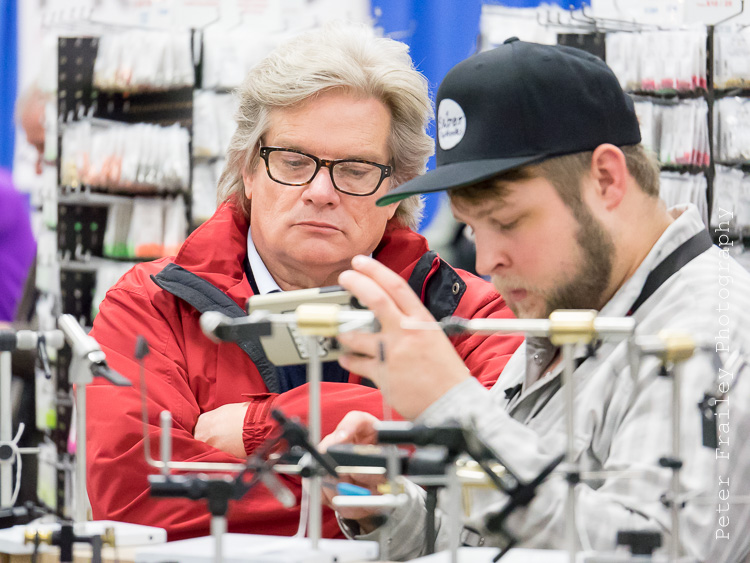
Last weekend I took the Panasonic 35-100 mm zoom (70-200 mm equivalent on a Panasonic or Olympus digital camera) to the annual Fly Fishing Show in Marlborough, MA. I should use this lens more often. It's relatively small and light for an F2.8 lens (just 12.7 ounces and 3.9" long). Because it has internal zooming, it does not extend or "trombone" like so many lesser lenses. I think this actually makes it easier to hold steady.

Panasonic 35-100 F2.8 attached to an Olympus E-M1


I found in looking at my Lightroom catalog of images that the last time I used this lens was a year ago.  It was at the same event, on the same weekend in January. I guess because I don't do much people photography, this lens is a bit of a niche player for me, and so doesn't get a lot of use.  But I do love it!

While I walked around the show randomly photographing people I could see why this focal length range is so important to wedding photographers. I took all my photos at the maximum  F2.8 aperture so as to isolate the subject (i.e. blur backgrounds and foregrounds), something I could not have done with the kit 40-150 F4-F5.6 zoom.  Not to mention that even at F2.8 I sometimes needed ISO 6400 for a decent exposure. 

[You might wonder why I don't take this lens with me for landscapes and travel. Well, 70% of my travel needs are quite adequately taken care of by the Olympus 12-40 F2.8. For the rest, the kit 40-150 mentioned above is quite satisfactory.  It provides a bit more reach too. As expected, for a slower lens, it is even smaller and lighter than the 35-100.  And because I'm usually shooting at F4 to F8 for depth of field purposes, an expensive, heavier, bigger lens is unnecessary.]  

Here are a few of my favorites from the Fly Fishing Show:

The first four were taken at ISO 6400, F2.8 and shutter equal to 1/equiv. focal length.


The next nine were taken at ISO 3200 to 5000


Taken between ISO 500 and 2500


7.04.2015

Macro set up #2: Olympus E-M1 + Panasonic 35-100 + Canon 250D close up lens

This set-up is similar to the one used for the flower photos in the previous post and which is shown two posts-ago here.  But instead of using the 500D closeup lens designed to focus a zoom lens at 50cm (about 20"), the 250D is designed to focus a zoom lens at 25cm (about 10").

The 250D is slightly thicker, perhaps because of its
greater magnification. More magnification = more glass.

Olympus E-M1 plus Panasonic 35-100mm plus Canon 250D close-up lens

This is what I found out on the Panasonic 35-100:

The advantage of the 250D is increased magnification. Assuming the lens is all the way zoomed in at 100mm (FF=200mm), by cutting the focusing distance to 10", the 250D gives close to a 1:1 macro (FF equivalent). The 500D  can only give you about a 1:2 macro (FF equivalent).

But with greater magnification comes decreased depth of field.  The depth of field with the 250D is so thin that I found it necessary to use F5.6 or F8, whereas with the 500D I used F2.8 or F4.

Depth of field at F2.8 and 100mm (FF 200mm) = Perhaps 1/2".

Depth of field at F8 and 100mm (FF 200mm) = Perhaps 3/4".
But with more gradual fall off giving the appearance of much more DOF.


Regardless of the one you use, or with any other acromatic lens for that matter, it takes some getting used to.  Your lens will not focus at infinity!  The 10" and 20" focusing distances are not minimum focusing distances, they are essentially the focusing distance.  That is why they work best on a zoom.  To widen your composition you can't move further back more than a few inches from the subject. Instead, you need keep the same focusing distance and zoom out.


Zoomed in at 100mm (FF 200mm)

Zoomed out at 35mm (FF 70mm)

The photos below were all taken with the 250D.  However, for flower photography I prefer the greater working distance of the 500D.  With less magnification, the depth of field is greater, and I can consequently use a bigger aperture thereby allowing more light to enter the lens.  The more light entering the lens, the lower the ISO required and/or the faster the shutter speed, both of which are good things.  Also, the 500D seems to be more forgiving when it comes to focusing distance.  The sweet spot is 20", but it seems I can go a couple of inches more or less than 20" and still lock focus.

Zoomed back to 65mm.  F8

At 100mm.  F8

At 100mm. F8

At 100mm. F8

80mm. F4

35mm. F2.8


6.29.2015

Macros from Olympus E-M1 + Panasonic 35-100 + Canon 500D close-up lens

Though I have several dedicated macro lenses, I chose to take this makeshift arrangement (refer to my blog title) to the botanic gardens on Saturday.  I have had the Canon close-up lenses for many years and have used them on a number of cameras, well before I purchased my first macro lens.  From time to time it is fun to take these acromatic close-up lens out of their cases and give them a "go".

For more details and explanation see my prior post.

In all of these cases, aperture was F2.8.  I'm not sure that gave enough depth of field. You may like or not like the result.  But my desire was to get a blurry, creamy background if possible, and for that a large aperture is needed.

Except where indicated, these were shot at full zoom of 100mm (FF=200mm). With this combination of camera and lenses, when zoomed into 100mm, depth of field is about 1/4".

Here's what I got:


75mm (FF=150mm)