Showing posts with label fall. Show all posts

11.08.2018

One Photo: Favorite Fall Photo

I didn't get many fall images this year, and I have little hope until next year.  We have had a lot of rain and wind, and I have read that the record high moisture in the air (high dew points) and the longer non-frost season, are not good signs for our maple trees.  And it is the maple tree that gives us our brightest colors.

All that being said, I did like this image taken about a month ago in Maine. Trees near fresh water tend to change colors first.

"Beaver Pond"
Olympus E-M1 with Olympus 12-100mm F4 zoom @70mm (140mm-e)
F8
ISO 500
1/160 sec
Lightroom Classic

10.23.2018

One Photo: Fall Blueberry Barren in Maine


Seen here is a tract of managed blueberry barrens.  Soil here is naturally nutrient-poor and acidic. Apparently this is perfect for blueberries, though since this field is harvested commercially, I am guessing that some fertilizer is added to the mix. 

Barrens are wide open areas that are flat or hummocky and covered with dwarf shrubs, like these lowbush blueberries. There are also often “carpets” of reindeer lichen, though I don’t see any from this angle.


"Fall Blueberry Barren"
Blue Hill, Maine
Olympus E-M1 and 12-100mm F4 zoom @ 54mm
Auto ISO 200, Aperture priority F8, 1/125 sec
Processed in Lightroom Classic CC


What is particularly remarkable is that these lowbush shrubs (which are green and of course “chock full” of blueberries in the summer) have some of the first leaves to turn color in fall. And this is a bright red and/or orange!  Unfortunately, summer travelers in Maine never get to see this spectacular fall display.

[These barrens are owned by a friend of mine.  Last summer we picked berries along the edge of this road.  My wife and I picked a couple of quarts each, in just minutes.]


11.22.2017

I Had To Be Content With Dried Flowers and Flora

Two days ago I went for a walk in the woods with the Panasonic GX85 and Olympus 12-100 lens, looking for things to photograph.  Outdoor photography is difficult this time of the year.  The days are getting colder and the color is gone.  Stuff is dried up and dead (except for the evergreens and a few of the ferns).  Nevertheless it was nice to get out and breath fresh air.  I walked slowly and looked around a lot. I am pleased (but not exactly excited) with a few of the images. Below is a small selection.

The close up images were taken at 100mm (200mm equivalent), 1/250sec, F4, and auto ISO varied from 320 to 1600 depending on the amount of light available.


This is my favorite because of the background.
A bit of overexposure worked nicely here.
1 1/3 stop positive EV compensation used.


11.19.2017

One Photo: A Single Oak Leaf with Lightroom's New Masking Tool


Yesterday I went for a long walk, leaving the house with my new (for me) small camera and lens.  Last month I bought a used Panasonic GM5 from eBay and I already had the mini (about 3 ounces) 12-32 zoom. 

This is a mFT camera so all my lenses for my Panasonic and Olympus gear fit the GM5, though the camera is so small I haven’t yet determined which lenses will be comfortable to use on it.  I am also hoping it will weather the winter enough to go with me skiing, as I want something with better image quality than my old but trusty Panasonic TS3 point and shoot weather-proof camera.

The camera and lens fit wonderfully in my jacket pocket.  It is a sturdy little camera, but the total weight of body, lens, cap, battery and memory card is only 10 ounces.

What you see below hardly needed me to carry the camera very far.  It’s actually the only photo I took on my 45 minutes walk, and it was only 10 feet from our front door.  We had had an overnight frost and there were a few oak leaves that had blown down overnight and were residing on the lawn.  (The maple leaves had fallen and been removed a while ago.)  Usually, fall oak leaves are not exactly “pretty”, certainly when compared with the reds and yellows and oranges of maple leaves.  Fallen oak leaves are usually shades of brown.  But add a bit of frost to their undersides and they take on new life.

The leaf I chose to photograph was a near-perfect specimen.  Since I have the before and after images below you can see that I did nevertheless boost the colors to what I believe is the upper end of the range of normal oak leaf color variation, while at the same time darkening the background.  Which image is “better” is indeed a matter of personal preference.  What I enjoyed in creating the “after” image is playing with Lightroom Classic’s new masking range tool.  Basically, this is what I did:


  1. Darkened the entire exposure by about 1.5 stops in the basic panel
  2. Used the selection brush to paint over the leaf.  I usually hit the “o” key (I believe it stands for overlay in this case) which shows the painted areas as red.
  3. From here I only worked in the “mask” and  “brush” panels
  4. Turned on the mask to “color” 
  5. Turned off the overlay (hit the "o" button again)
  6. Used the dropper to define a rectangle of the leaf with the color I wished to work with
  7. Added 1.5 stops of exposure to the masked leaf, and played with all the rest of the sliders to taste.


Frosted Oak Leaf
Panasonic GM5 plus 12-32mm zoom @ 32mm (64mm equiv)
1/100, aperture priority F5.6, autoISO200
Processed in Lightroom Classic CC


Frosted Oak Leaf
SOOC


.

9.25.2017

Philosophical About Fall Maple Leaves

Over the weekend, while mostly lying on my back watching football on television after a back sprain earlier in the week, I decided I needed to go outside, walk around the property, and see if there were any photos to be had. I needed some fresh air and some camera-time between back exercises!

I thought I might get a nice photo from among the growing number fall-colored maple leaves that had fallen to the ground, and I looked for a perfect specimen as a model. The task was impossible....there were so many that were quite attractive but nowhere near " perfect ". The one below is an example. 

For some reason after holding and photographing this leaf (against a blurred and richly green background which is our lawn), and then admiring its own beauty on my computer screen, I got a bit philosophical.

I thought to myself that the downed maple leaves were a lot like people: each is unique, all have imperfections, and most (many ?) are beautiful in their own way. 

Fall Maple Leaf - Imperfect But Beautiful
Panasonic GX80/85 with 60mm Olympus F2.8 Macro
1/125sec, F4, ISO 200

9.15.2017

Photo Story: First Signs of Fall?

After a bit of dark and gloom and rain today, the sun came out in the late afternoon as I went out of the house and down the driveway to the mail box.  The sun had a really nice angle on these well-lichened maple trees in the wetlands beside our house, and it is the neutral colored bark of these trees that made this vine of Virginia Creeper stand out and catch my eye.  The leaves had recently turned a brilliant red, and they were on display in the afternoon sunlight.  As we know, it's all about the light.

I read on the Internet (so it must be true!) that Virginia Creeper is sometimes grown as an ornamental plant because the leaves turn a brilliant red in the fall.  I certainly agree with the red part of that statement.  But it's hard to think of actually planting this vine.  It's much less problematic for us than the Bittersweet vines which wrap around a trunk and eventually strangle a tree.

At least Virginia Creeper grows straight up the trunk.  However, it is all over the place.  The vines grow along the ground sending roots down into the soil, until the vine finds a tree to climb. According to the "Ohio Weedguide" put out online by The Ohio State University, each vine can grow 20 feet per year. No wonder I keep pulling it out of the garden.

Panasonic GX80/85 plus Panasonic 100-300mm @ 300mm
1/640, F5.6, ISO200

10.26.2015

A few final (?) fall images.

I took some time on Friday to jump in the car to look for some final fall foliage.  It was a bit cloudy and windy, and leaves were falling fast, but I did at the very least find some spots that might yield good images next fall.

The lack of light was generally a problem because the clouds were thick.  Even bright colored maple leaves need light from the sky to be at their best (generally).

Below are five images I decided keep.


10.20.2015

A couple of fall iPhone shots

Sometimes it pays to get off the highway.

I was trying to get to my dad's nursing home for a visit last Friday, when I came upon a huge traffic back-up on the three lane highway I was traveling. My solution was to get off at the next exit. I meandered my way through the rural countryside around Bolton, MA.  The scenery was beautiful, though fall foliage was probably a week short of "peak".

The only camera I has was the one on my iPhone.  Here are two shots I liked.  Other than perhaps being limited by the wide angle (equivalent to 30mm on a full frame camera), I was limited in these two images by wire cattle fences or "no trespassing" signs.


In the image below, if you follow the line of clouds into the distance you will come to Mt. Wachusetts near Worcester, MA.

11.01.2014

Autumn Macros - Page 1

I was hoping to get a day outside this weekend, traveling by car to capture some more fall foliage scenes.  But as of today, when I look at my "leaf peepr" cell phone app, I see that the foliage just about everywhere in New England is past peak.

The exception is the Cape Ann/Gloucester/Rockport area of northeastern Massachusetts. That being said, even though the weekend is upon us, the weather is terrible.  Temps are in the mid-40's, it is raining, and the wind is gusty and blowing out of northeast.

There's even talk of snow tonight. Yuck.

So, inside projects are the order of the day. For me that means I have an opportunity to clean up some of the photos in my Lightroom library. What I discovered this morning is that I have taken a fair number of macros this fall, some of which I have posted below.

I find that occasionally I take my camera and walk around the yard looking for plants and insects to photograph.  That's where these images were taken.

This fall I seem to be experimenting a lot with auto focus versus manual focus. And with manual focus, I have been experimenting with and without focus-peeking enabled. So far, I can't say that I see any difference in the results.

These images were taken with a mixture of the following lenses:

  • Olympus 12-40 F2.8
  • Panasonic 35-100 F2.8 with Canon 500D macro lens screwed into the filter threads
  • Olympus 60mm F2.8 macro
  • Olympus 40-150 F4-F5.6 with Canon 500D
  • Tamron 90mm F2.8 macro

Generally I use F2.8 to get the blurriest possible background.  Shallow depth of field is a consequence of using a large diameter aperture, and that may or may not be desirable.  However, that plus letting ISO go as high as 1600 allows for a fast shutter speed.  And that means the tripod can stay in the car! 

Slightly more than half of these were shot at F2.8.  Because at that aperture it is very easy to miss focus, I usually take several shots.  I do not shoot a burst, but instead consciously and slowly refocus for each repeating shot.  

The images that were not at F2.8 were mostly taken with the Olympus 40-150 F4-F5.6 zoom, where F2.8 is not available.

Larger Images and EXIF information on my Website here:
http://www.peterfraileyphoto.com/blogimages2014nov1


This is a flower on our male holly bush.
In white, but sometimes also yellow, you can see the four stamens
of a male holly flower.  Holly flowers, both male and female
have four petals. The flower measures only 1/4" across.


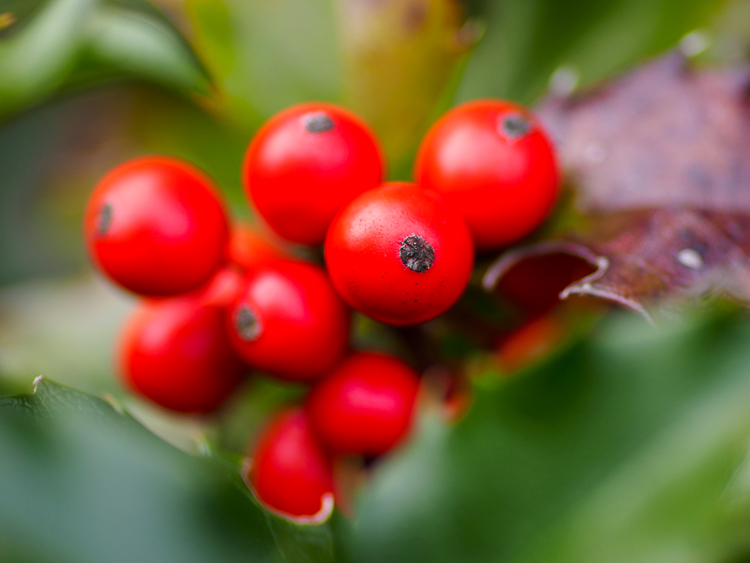
These are the berries on our female holly bush.
You can't have berries without pollination from the male flower.

10.24.2014

Searching for Autumn Color - Page 2

As a follow-up to my little excursion last Wednesday, which I commented on in the prior blog post, I decided that I would take last Friday (a week ago today) and explore a bit of southern New Hampshire. My goal was to drive "the long way" to Jaffrey, New Hampshire and the Mt.  Monadnock area.

For the first time in five or six years I brought along (and used) a polarizing filter. I was expecting a bright  blue sky and puffy clouds, and thought the polarizer would give me some really nice results. 

Even though I am happy with how the sky and clouds turned out in the images, I'm not completely convinced that a polarizer is worth the hassle.  That's because with software like Photoshop and Lightroom, it is fairly easy to approximate a polarized look by adjusting saturation and luminescence sliders. The results are not quite as nice as what a polarizer can do, but it takes no fumbling with additional equipment in the field. And some would even argue that adding a filter on top of a lens downgrades image quality by adding more glass layers through which light must travel. I can certainly say that it creates two more glass surfaces that must be kept clean!

A hassle (for me) is that the sun must come from a specific angle for the polarizer to have full impact. In addition, for each shot, I need to remove the lens hood to be able to rotate the polarizer to its proper placement for that specific composition.  Following that, the hood must be replaced, while at the same time hoping that the action of twisting the hood onto the lens does not also rotate the polarizer.

All that being said, I do plan to experiment more with polarizers. Not only when the sky is blue, but also for close-ups of flowers and foliage, where in many situations the polarizer can reduce glare and make colors richer.

A few from my fall excursion to Jaffrey:


In the center and in the distance is Mt. Monadnock.
The perspective of the 24mm-e lens used here makes it look
smaller and further away than it actually is.