7.18.2011

Fill-Flash can be used for more than people shots

Fill flash seems to be most used (I am guessing here)  to fill in the shadows of people being photographed with the sun at their backs.  But last year my eyes were opened to other uses of fill flash when I saw a flash-aided photo of a sunrise.  Of course, the flash will do nothing to lighten up a distant sunrise, but in this case it was used to lighten up wildflowers in the immediate foreground.  That taught be something, and caused me to try the photos below.

The pictures below were taken on a recent vacation trip to Maine, on a foggy morning.  I am not saying these are "good" or "bad" pictures, but they do demonstrate the use of a fill flash to lighten up the immediate foreground.

These first two pictures are obviously before and after shots.  The second shot shows the back of the chairs as they looked to the human eye, using the fill flash.  But you may like the first shot better because of the greater contrast.


This final picture is an after shot.  Unfortunately, against my self-imposed guidelines, I deleted the before shot before I downloaded it from the memory card.  So, the before shot is lost forever.  That's too bad, as the difference is remarkable.  In fact, the flash during the shot below was so short in duration (aren't flash speeds measured in thousandths of  a second?) that my eye never saw the light bouncing off the reflector material on the surface of the sign.  I only noticed it when I viewed it afterward on the LCD.


6.30.2011

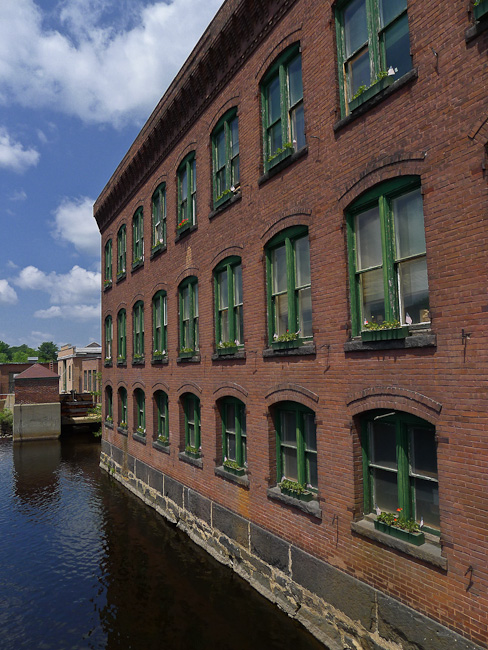
Old Mill Town, Orange Massachusetts

This was really supposed to be a day-trip to the Millers River in central Massachusetts to do some trout fishing.  But as luck would have it, I forgot my fishing waders and definitely was not going to wade these cold waters with only in my nylon shorts and open sandals!

So, I moved to Plan B.  I had brought along my Panasonic LX5 and decided I would spent a few hours photographing scenes along the river. 

Below are a few images taken in the old mill town of Orange, Massachusetts. 


The final shot below is my favorite of this set. To get the red and green colors of the old buildings on the left, while at the same time getting a good exposure of the sky, I shot a 3-shot exposure bracket with one image being 2-stops overexposed and one image being 2-stops underexposed. The overexposed image was perfect for exposing the buildings (which otherwise would have been in darkness) and the underexposed image was perfect for the sky. Combining the three exposures resulted in a more even exposure throughout the scene.


6.18.2011

Three pictures from the coast of Maine

Early this month my wife and I drove up to the state of Maine for my college reunion.  We couldn't help but drive up the coastal road, as the weather was beautiful and cool and the shore traffic was light.  Here are three images I took using the Panasonic LX5 near Kennebunk.  I used a couple of tricks which I explain in the descriptions below each image.

Kennebunk Beach before the summer crowds, using a lens adapter and  polarizer filter.  The 4:3 aspect ratio makes for a nice vertical landscape format.  This was taken with the zoom fully zoomed out at 24mm (equiv) wide angle


Kennebunk Harbor.  Two-image panorama combined automatically in photoshop CS5.


President George Bush estate.  I combined three images taken at different exposures.  The house is still too dark.  If I did this again I would use a wider three-image bracket of +/- 2 f-stops, rather than 1 f-stop.  The LX5 will shoot three-image brackets at a maximum of 3 f-stops variance (in other words, normal exposure, +3 stop exposure, and -3 stop exposure.)

6.01.2011

Nine Months with the Panasonic LX5 and Canon S90

Aside from the smaller size and portability of the S90, I believe the LX5 is a superior camera with regard to features and handling (for my purposes). Having said that, it's too bad the LX5 doesn't slip into my pocket like the S90. But if it were built for pocketability Panasonic probably would have omitted the hot shoe and the ergonomic tacky-surface grip. We might also have lost the F2 wide angle lens. Omission of these features would have been terrible. I love 24mm wide and find on a trip I take perhaps 25% of my images at the 24mm wide setting. I have to assume that a lens of this specification cannot be engineered to retract fully into the body. And this leaves us with some lens protrusion even when powered down, and an inconvenient lens cap. Actually, I don't find the lens cap itself inconvenient, but the fact that the camera needs to be fully powered down before you can put the lens cap on is annoying.

When it comes to image quality, I believe it's a toss up. The RAW files on both are "good enough", and after a few in-camera adjustments I'm happy with the jpegs from both. Let me note, however, that this is based on viewing images at "normal" viewing distances, both on screen and in prints, the largest of which has been 8x12 and 9x12.  The sensors on both of these 10 megapixel cameras are essentially the same size, and bigger than what are found on 99% of all compact cameras.  All things being equal, larger sensor size improves image quality.

So which do I prefer? A camera strong in features with a robust feel like the LX5? Or, a smaller, sleeker camera with slip-into-your-pocket portability like the S90?

My initial response is that I prefer the LX5. But when I did some filtering in Lightroom I found that over the last nine months (the time period in which I owned both cameras) I have used them equally, as I have kept 900 images from each camera. What gives?

Looking at the 1800 images catalogued in Lightroom, I see that I use the S90 mostly when there is a "point and shoot" situation. I usually shoot the S90 in P-mode, auto ISO, RAW + JPEG, AWB. I typically dump the RAW file after determining that the JPEG is good enough. I'm picky about white balance so I might use the RAW if I need to make a white balance adjustment, or if I had been lucky enough to capture a potential "portfolio" shot. The additional features I use on the S90 are (1) plus or minus EV compensation while viewing the histogram, (2) three-shot exposure bracketing when appropriate for perhaps a possible conservative HDR, or when I am just not sure what exposure I want, and (3) the lens ring set for step-up zoom.

On the other hand, the LX5 goes with me when I'm being more serious about photography. I've used my Olympus 36R flash on it and love the results, and I have used a lens adapter for attaching a polarizer or closeup lens like the Raynox DCR-250. I also bought the LVF-1 viewfinder which I find very helpful for composing images depending on the amount and direction of sunlight.  Of course, all of this does make for an expensive kit!  But I already owned the flash and filters.

Here are some of my favorite features on the LX5:

1) The function button set up for auto exposure bracketing

2) The ability to shoot 3 exposure bracketed frames reasonably quickly (I think about 2-3 fps), though it takes a while to write to file. This helps when exposure bracketing for HDR use because it minimizes any hand movement between shots. (The S90 is a lot slower in taking 3 bracketed shots, perhaps 1 fps.)

3) The ability to set a minimum shutter speed when in P-mode. I've set up C-2, C-3 and C-4 custom modes for minimum speeds of 30, 60 and 125 seconds. The speed will automatically be bumped up if there is too much light for the minimum speeds. (And by the way, the LX5 has a maximum speed of 1/4000th second!)

4) AEL/AFL is set for focus lock. (The S90 has this button also.)

5) The ability to shoot in M-mode with autoISO. (I can't do this on either my S90 or G9.) This is one of my favorite ways to shoot. The operator picks the speed to match the subject and picks the F-stop for the desired depth of field, and the camera adjusts ISO to give the proper exposure based on the metering system you've selected

6) The ability to use an add-on flash or add-on viewfinder.

7) The ability to add filters via a lens adapter.

I guess the fact that I give these two cameras equal time tells me I like them equally... but clearly for different reasons. Frankly, when I first bought the LX5 I thought I was being a bit wasteful with my money because it would be redundant with my S90. I am now glad that I have both. They fit different needs.

I will enjoy watching the evolution of both series. The GF-series m43 cameras are nearly as small as the LX5. And if you love Olympus colors, the new Olympus XZ-1 is providing worthy competition to the S-series and LX-series.  Samsung has a contender, too. This is definitely a hot sector of the market.

5.30.2011

A few flower closeups from the front yard today

Recovering today from a heavy cold, I decided to take a few minutes outside to "experiment" with my cameras.  These are taken with the Olympus E520 and E620, with 70-300mm and 50mm lenses, a Panasonic LX5 with Raynox DCR-250 closeup lens and a Canon G9.  The panasonic is the most fun to use; it's very light, easy to hold, and focuses much quicker than my dSLRs, as both the 70-300 and 50mm do lots of hunting and frequently need to be manual focused on close subjects.

The first three were taken with the Panasonic


This next image was taken with the Canon G9

The next three were taken with the Olympus E520 and 50mm macro lens.


This final image was taken with the E-620 and 70-300mm zoom


5.21.2011

Found an old Vivitar polarizer in the bottom of my old camera bag. Fits and works nicely on my Panasonci LX5.

The other day I was cleaning out an old camera bag and found a 52mm Vivitar polarizer.  If I bought it, it was at least 35 years ago and probably more like 40 years ago.  It's the same size as the threads on my even older Nikon 50mm F1.4 lens (I wasn't the first owner of this fine legacy lens).

The polarizer was a bit cloudy coming out of the little clear plastic case, but I cleaned it up nicely with a bit of hot breath and the tail of my cotton t-shirt.  Is there any other way to clean glass!?

I frankly don't know how good this filter is.  And are filters for digital sensors different than those made for film? Does it make a difference?  I have no idea.


But regardless, it works nicely on my Panasonic LX5 compact camera, even at the widest setting on the 24mm-90mm (equiv.) zoom.... I should have tried a horizontal shot but I wanted to get the clouds and sky using a vertical shot.  Assuming we have another nice day tomorrow I'll give the landscape orientation a try, and see what I get.

The lens adapter is from an aftermarket ebay supplier but the filter end measures 52mm just like the Panasonic adapter. A perfect fit for 52mm filters.  It's nice too because my only other polarizers measure 67mm and 58mm.  I've used 58mm filters on the LX5 with a 52-to-58 step up ring, but using the right size is always slicker.


Anyway, here's the example I was happy with this afternoon.  Nice day, huh?  After a week of rain it was nice to get a reprieve.  Blue and green are great landscape colors.  I am very happy with Panasonic's metering system and always enjoy the live-view histogram.


4.26.2011

A trip to your local botanic garden is always a great idea in the spring

Tower Hill in Shrewsbury is always a great take.  These shots were from last Friday.  I have posted a set of 25 larger images here: http://www.peterfraileyphoto.com/botanicgarden2011apr22

Lots of pretty flowers, and stuff was beginning to pop everywhere.


4.11.2011

Club print "salon" entries for April, 2011

The color image was taken in Bucks Harbor, Maine, while on vacation last year.  For the Salon, I printed it square on 9x12 paper and matted it with a mat with a 8.75" x 8.75" opening.  The camera was the Canon S90 point and shoot.

It was taken in June and the high season for lobstering was beginning. I saw many lobstermen loading their boats with pots to take out to their fishing grounds. These pots don't have the class, in my opinion, that the old wooden pots had; but certainly from a maintenance point of view the new pots are way ahead of the wooden ones.

Lobster Pots at Bucks Harbor


This black and white image was taken along the Sudbury River in Concord, MA.  I printed it on 9"x12" paper to fit the 4:3 aspect ratio.  The camera was the Canon S90 point and shoot.

My thought is that the cloud reflection is the central subject and that the kayakers provide context and perspective.


Cloud Reflection on the Sudbury River

4.10.2011

Club digital "salon" entries for April, 2011

These three images were submitted for our photo club's monthly contest.  The red Columbine was entered into the nature category. 

The second two images were entered into the open category. The ducks are sitting on what is cut grass, so the "hand of man" is evident and therefore they do not qualify as nature, at least for our purposes. 

The butterfly image was taken in a butterfly house.  Like animals at a zoo, this does not quality as a nature photograph either. 


Eastern Red Columbine


Getting Your Ducks in a Row


Postman Butterfly


4.02.2011

My first butterfly images this year

I took an early morning trip to our nearby butterfly house this morning.  They open the doors an hour early for photographers on the first Saturday and Sunday of the month, during the season.  I like that first hour because the fans and heaters aren't yet going full blast, so the butterflies are still a bit sleepy.  I am pretty happy with the shots I took (link below).  All are taken hand-held at 1/250 second and (usually) F8.  Mostly ISO at 1600, with a few at ISO 800.  My camera settings: Manual mode set at my desired shutter speed and F-stop, and auto ISO.  All are with natural light, diffused somewhat through the glass dome of the butterfly house.

12 images here:

http://www.peterfraileyphoto.com/butterflyplace2011apr2

My favorite is the Glasswing.  Below are two images: