9.28.2011

Images from coastal Maine (part 2): Blue sky with puffy clouds

In my prior post I mentioned the advantages of image-taking during the golden hours.  On the other hand, this is rather limiting when you are traveling. 

All of the images below were taken mid-day.  I took them mid-day because that is the time I was there!

I love blue sky and puffy clouds and the sky is often its blueist mid-day and when the sun is at your back.  But you need to watch your exposure.  The white clouds are easy to overexpose, and they will look like featureless white blobs.

A strategy for dealing with this is to use a bit of "exposure compensation" (perhaps minus 2/3rd of one stop) to retain the detail in the clouds. Even the simplist cameras will often have this feature, often referred to as EV compensation.  Usually you will have a button or a menu item that is written as "+/-". Adding "+" numbers will result in a brighter exposure. Adding "-" numbers will reduce the light and make the overall picture darker or less exposed.

By adding -2/3 EV compensation the clouds will look better, but the shadows in the foreground will get darker.  This is not necessarily a bad thing.  But if you want to fix it, a bit of "fill light" in processing software like Adobe Lightroom can often help.

I'm not sure I was entirely sucessful in these shots, but I don't think the clouds are noticeably "blown out".

__________

The next three images were taken at Colonial Pemaquid State Historical Site, and the site of Fort William Henry that was originally built in 1692


Pemaquid Lighthouse


Whitehead Light Station


Birch Point Beach State Park.  Beaches up there are never crowded... it seems; though this was taken on Thursday, June 30th, just before the long 4th of July weekend.


Near Owls Heads Lighthouse


Public Beach south of the center of Camden


Belfast waterfront


Bridge over Penobscott Narrows, Bucksport


From the town landing in Blue Hills

9.24.2011

Images from coastal Maine: The golden hour

The "golden hour" is often viewed as the best time to take photographs.  Typically it's one hour after sunrise and one hour before sunset.  But I believe this has to be taken loosely, as it depends on your location.  Technically, according to Wikipedia, the golden hour is created when the sun is at an altitude of 10-12 degrees.  In the Arctic circle I think this could last most of the day.

The golden hour is known for its soft and warm light.  There are no harsh shadows or bright highlights, such as occur during the middle of the day, and which are hard for a camera to record.

During a two week vacation in Maine, I took a few images during the golden hour.  However, with the sunrise so early in the morning (twilight around 4:45, as I recall) it was pretty hard to motivate ourselves to wake up, grab coffee, and go out and meet the morning mosquitoes.

The first three were taken with a point and shoot camera.  I'm a big fan of small cameras.  In the first instance, I took shots with both a point and shoot and a dSLR.  Though technically the dSLR had better results (but not that much better), the lighting and composition was just a little better with the point and shoot.  It goes to show me that lighting and composition are far more important than the camera you are using.

In the second and third scenes a point and shoot was I had with me at the time.  And the final shot was taken with an Olympus dSLR with my best lens.  I tried this final scene with my point and shoot, but it just didn't get as much detail out of the clouds as did the dSLR.

Two mornings:


Two evenings:


9.18.2011

Some shutter therapy at Tower Hill Botanic Gardens today

I wanted to get out and take some pictures today.  The sky was awesome and the weather dry and cool, though there with a bit more wind than I like for flower photos.  The drive to Tower Hill is easy for me and I always enjoy stopping at Davidian's Farm Stand for a couple of  Apple Cider Donuts on the way.

Overall there seemed to be lots of flowers, but upon closer examination it was clear than many were past their prime.  But after all, it is the middle of September and summer is almost over.

Based on what I see in the few pictures I did take, the bright day allowed me to easily shoot at high speed even with low ISO and this was sufficient to freeze the action.  I used my Panasonic LX5 for all of these shots.  As always, these are hand-held.


9.17.2011

Butterfly page updated to include 55 images

I just had some fun going through all of my butterfly images.  I have about 250.  I've selected 55 which I think are good enough to upload to the Web site.  The selection can be viewed at:

http://www.peterfraileyphoto.com/butterflies

9.13.2011

Club digital "salon" entries for September, 2011

This month's salon theme was "Child(ren) at Play".  This image was taken in the spring before the topic was known; so, I feel pretty luck to have captured it.  What fun to run through a field of flowers! 

(The rest of the story is that this little girl's mother was soon scolding her for not staying on the path, which you can slightly see in the background.)

Galloping Through the Dafodils

The following two images were for "open" competition.  The dafodil was in our front yard looking good on a hazy spring morning.  The butterfly in the second image below could not have been entered into the "nature" category because it was taken in a butterfly house.  It's usually hard to get a background that isn't distracting.  Though brown isn't exactly my favorite color, I think it works well here as a background.  It's actually out-of-focus brickwork on a path through the butterfly house.

Dafodil Closeup


Longwing Butterfly on Flower

9.11.2011

Club print "salon" entries for September, 2011

The color image was taken at about 5 a.m., near Spruce Head, Maine, while on vacation earlier this summer. The camera was the Panasonic LX5 point and shoot.  I also took images with an Olympus dSLR, but for some reason the compositions I got with the LX5 trumped any improved image quality that may have come from the dSLR with its much bigger sensor.  Indeed, I have been very impressed with the quality of the images that are coming from this small camera. 

Sunrise at Low Tide

The black and white image was taken in Cape Rosier, Maine. It too was taken with the LX5. This storm came upon us very quickly at about 8 p.m. in July. You can see the edge of the front in the distance.  The storm was coming from behind me.

Coastal Storm Front

7.18.2011

Fill-Flash can be used for more than people shots

Fill flash seems to be most used (I am guessing here)  to fill in the shadows of people being photographed with the sun at their backs.  But last year my eyes were opened to other uses of fill flash when I saw a flash-aided photo of a sunrise.  Of course, the flash will do nothing to lighten up a distant sunrise, but in this case it was used to lighten up wildflowers in the immediate foreground.  That taught be something, and caused me to try the photos below.

The pictures below were taken on a recent vacation trip to Maine, on a foggy morning.  I am not saying these are "good" or "bad" pictures, but they do demonstrate the use of a fill flash to lighten up the immediate foreground.

These first two pictures are obviously before and after shots.  The second shot shows the back of the chairs as they looked to the human eye, using the fill flash.  But you may like the first shot better because of the greater contrast.


This final picture is an after shot.  Unfortunately, against my self-imposed guidelines, I deleted the before shot before I downloaded it from the memory card.  So, the before shot is lost forever.  That's too bad, as the difference is remarkable.  In fact, the flash during the shot below was so short in duration (aren't flash speeds measured in thousandths of  a second?) that my eye never saw the light bouncing off the reflector material on the surface of the sign.  I only noticed it when I viewed it afterward on the LCD.


6.30.2011

Old Mill Town, Orange Massachusetts

This was really supposed to be a day-trip to the Millers River in central Massachusetts to do some trout fishing.  But as luck would have it, I forgot my fishing waders and definitely was not going to wade these cold waters with only in my nylon shorts and open sandals!

So, I moved to Plan B.  I had brought along my Panasonic LX5 and decided I would spent a few hours photographing scenes along the river. 

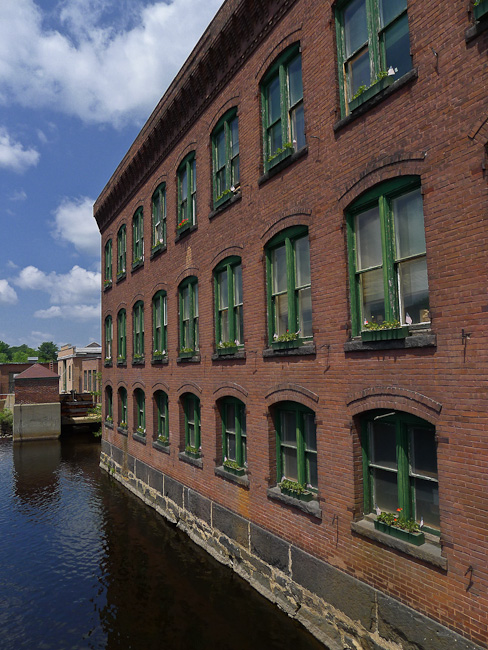
Below are a few images taken in the old mill town of Orange, Massachusetts. 


The final shot below is my favorite of this set. To get the red and green colors of the old buildings on the left, while at the same time getting a good exposure of the sky, I shot a 3-shot exposure bracket with one image being 2-stops overexposed and one image being 2-stops underexposed. The overexposed image was perfect for exposing the buildings (which otherwise would have been in darkness) and the underexposed image was perfect for the sky. Combining the three exposures resulted in a more even exposure throughout the scene.


6.18.2011

Three pictures from the coast of Maine

Early this month my wife and I drove up to the state of Maine for my college reunion.  We couldn't help but drive up the coastal road, as the weather was beautiful and cool and the shore traffic was light.  Here are three images I took using the Panasonic LX5 near Kennebunk.  I used a couple of tricks which I explain in the descriptions below each image.

Kennebunk Beach before the summer crowds, using a lens adapter and  polarizer filter.  The 4:3 aspect ratio makes for a nice vertical landscape format.  This was taken with the zoom fully zoomed out at 24mm (equiv) wide angle


Kennebunk Harbor.  Two-image panorama combined automatically in photoshop CS5.


President George Bush estate.  I combined three images taken at different exposures.  The house is still too dark.  If I did this again I would use a wider three-image bracket of +/- 2 f-stops, rather than 1 f-stop.  The LX5 will shoot three-image brackets at a maximum of 3 f-stops variance (in other words, normal exposure, +3 stop exposure, and -3 stop exposure.)

6.01.2011

Nine Months with the Panasonic LX5 and Canon S90

Aside from the smaller size and portability of the S90, I believe the LX5 is a superior camera with regard to features and handling (for my purposes). Having said that, it's too bad the LX5 doesn't slip into my pocket like the S90. But if it were built for pocketability Panasonic probably would have omitted the hot shoe and the ergonomic tacky-surface grip. We might also have lost the F2 wide angle lens. Omission of these features would have been terrible. I love 24mm wide and find on a trip I take perhaps 25% of my images at the 24mm wide setting. I have to assume that a lens of this specification cannot be engineered to retract fully into the body. And this leaves us with some lens protrusion even when powered down, and an inconvenient lens cap. Actually, I don't find the lens cap itself inconvenient, but the fact that the camera needs to be fully powered down before you can put the lens cap on is annoying.

When it comes to image quality, I believe it's a toss up. The RAW files on both are "good enough", and after a few in-camera adjustments I'm happy with the jpegs from both. Let me note, however, that this is based on viewing images at "normal" viewing distances, both on screen and in prints, the largest of which has been 8x12 and 9x12.  The sensors on both of these 10 megapixel cameras are essentially the same size, and bigger than what are found on 99% of all compact cameras.  All things being equal, larger sensor size improves image quality.

So which do I prefer? A camera strong in features with a robust feel like the LX5? Or, a smaller, sleeker camera with slip-into-your-pocket portability like the S90?

My initial response is that I prefer the LX5. But when I did some filtering in Lightroom I found that over the last nine months (the time period in which I owned both cameras) I have used them equally, as I have kept 900 images from each camera. What gives?

Looking at the 1800 images catalogued in Lightroom, I see that I use the S90 mostly when there is a "point and shoot" situation. I usually shoot the S90 in P-mode, auto ISO, RAW + JPEG, AWB. I typically dump the RAW file after determining that the JPEG is good enough. I'm picky about white balance so I might use the RAW if I need to make a white balance adjustment, or if I had been lucky enough to capture a potential "portfolio" shot. The additional features I use on the S90 are (1) plus or minus EV compensation while viewing the histogram, (2) three-shot exposure bracketing when appropriate for perhaps a possible conservative HDR, or when I am just not sure what exposure I want, and (3) the lens ring set for step-up zoom.

On the other hand, the LX5 goes with me when I'm being more serious about photography. I've used my Olympus 36R flash on it and love the results, and I have used a lens adapter for attaching a polarizer or closeup lens like the Raynox DCR-250. I also bought the LVF-1 viewfinder which I find very helpful for composing images depending on the amount and direction of sunlight.  Of course, all of this does make for an expensive kit!  But I already owned the flash and filters.

Here are some of my favorite features on the LX5:

1) The function button set up for auto exposure bracketing

2) The ability to shoot 3 exposure bracketed frames reasonably quickly (I think about 2-3 fps), though it takes a while to write to file. This helps when exposure bracketing for HDR use because it minimizes any hand movement between shots. (The S90 is a lot slower in taking 3 bracketed shots, perhaps 1 fps.)

3) The ability to set a minimum shutter speed when in P-mode. I've set up C-2, C-3 and C-4 custom modes for minimum speeds of 30, 60 and 125 seconds. The speed will automatically be bumped up if there is too much light for the minimum speeds. (And by the way, the LX5 has a maximum speed of 1/4000th second!)

4) AEL/AFL is set for focus lock. (The S90 has this button also.)

5) The ability to shoot in M-mode with autoISO. (I can't do this on either my S90 or G9.) This is one of my favorite ways to shoot. The operator picks the speed to match the subject and picks the F-stop for the desired depth of field, and the camera adjusts ISO to give the proper exposure based on the metering system you've selected

6) The ability to use an add-on flash or add-on viewfinder.

7) The ability to add filters via a lens adapter.

I guess the fact that I give these two cameras equal time tells me I like them equally... but clearly for different reasons. Frankly, when I first bought the LX5 I thought I was being a bit wasteful with my money because it would be redundant with my S90. I am now glad that I have both. They fit different needs.

I will enjoy watching the evolution of both series. The GF-series m43 cameras are nearly as small as the LX5. And if you love Olympus colors, the new Olympus XZ-1 is providing worthy competition to the S-series and LX-series.  Samsung has a contender, too. This is definitely a hot sector of the market.