8.20.2014

Two Weeks in Nova Scotia - Page 4: Lunenburg to Halifax

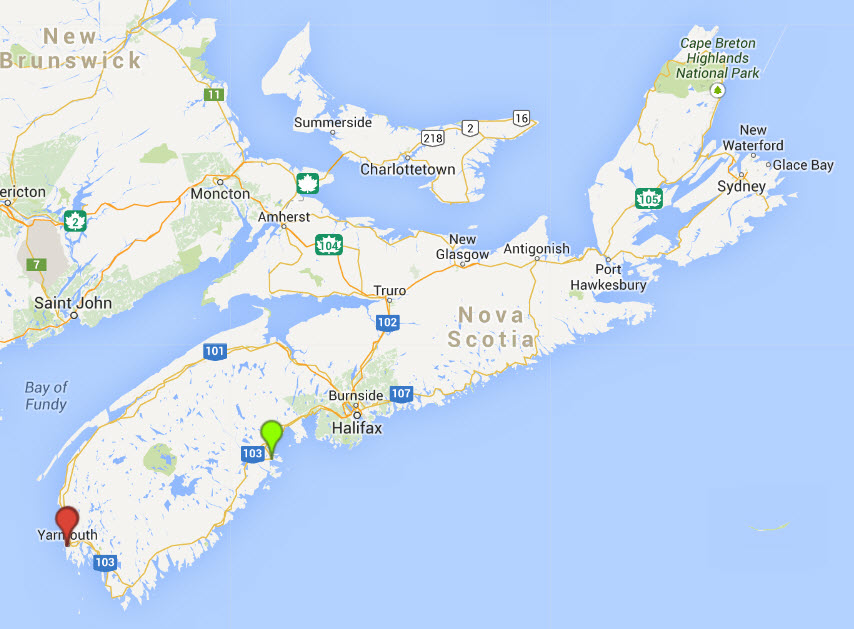
The day's destination is the green pin, Halifax

Favorite Takes

1) Northwest Cove

This small cove on the western side of St. Margaret's Bay was actually the day's highlight as far as we were concerned.  Perhaps that is because of our preference for "picturesque fishing villages", which we affectionately called PFVs!

Side comment: I'd like to point out that signage is terrible on Nova Scotia and many of the roads we chose to take to find PFQs (often 8 or 10 mile dead end dirt roads) were not on the map.  In many ways that made the travel more fun.  But more than once the signage would stop as soon as we approached a fork in the road. At that point it was "eeny meeny miny moe".


2) Peggy's Cove

Predominantly featured in all the guide books, is Peggy's Cove.  Don't get me wrong.  We visited it, and it was indeed very attractive, but it was also our first experience with tour buses, of which there were four or five parked side-by-side in an oversized paved parking lot.  During the entire remainder of the trip, we never encountered more than one bus at any spot.  On the other hand, we made sure we traveled roads and sought small venues where we didn't expect but a few other travelers.

I worked hard to keep the hordes of people and tour buses out of the images. My favorite is the final image.  The hazy sky cleared up for this image, giving a nice blue with puffy clouds.  My favorite kind of sky.


8.19.2014

Two Weeks in Nova Scotia - Page 3: Yarmouth to Lunenburg

The road trip from the ferry dock in Yarmouth to the city of Lunenburg was 180 miles.  This is  bit long for us because we like to stop and browse along the way, or better yet, get lost on side excursions.  But we had no problem checking into our hotel by a very reasonable 4pm.

The day's destination is the green pin, Lunenburg

Favorite Takes 

1) Shelburne

Our first favorite stop on this day was the historic district of Shelburne. The town was settled in 1783 by Loyalists leaving America after the Revolutionary War.  Though old, the town is small.  The current population is only 2,500.

Preservation of the historic district brought some money into the town in 1992 and 1995.  In the first instance, it became the setting for Fairfield, CT for the filming of Mary Silliman's War, a Revolutionary War movie. In the second instance it became the setting for the Scarlet Letter staring Demi Moore and Robert Duvall. I've not seen either move, but I plan to!

Below:  random images from the historic district.


2) Liverpool:

The Sherman Hines Photographic Museum is located in Liverpool.  Sadly, we were in town on Sunday... the only day of the week the museum is closed. Among other things, Hines is known for his interest in outhouses. You may have seen one of his annual outhouse calendars.

We did stop at a bookstore called Lane's Privateering Inn Bookshop and Gift Store, located inside an old inn and restaurant.  Here, Laurie bought her first of two Nova Scotia cookbooks, Maritime Fresh.

[Now, just a few weeks later, we've had the "Maple-Glazed Carrots", and the "Chicken with Mushroom Wine Sauce". Yummers.]


3) Lunenburg:

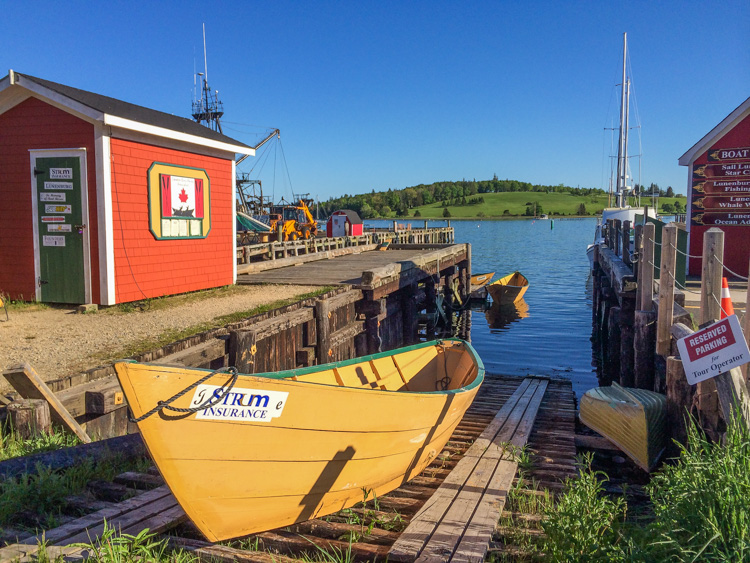
Most of these images were taken in Lunenburg's Old Town, a designated historic district. The famous schooner Bluenose, a Nova Scotia icon, was built here in 1921.  It is now the home of the Bluenose II, a replica built in 1963.

The Lunenburg Arms where we stayed.


The view from our room.


To the left, in the distance is the Bluenose II.  

8.18.2014

Two Weeks in Nova Scotia - Page 2: Portland ME to Yarmouth NS

On the map below, the red pin marks Portland, ME.  This map gives a sense of Nova Scotia's location relative to Maine and New England. Note that Yarmouth, NS is almost exactly east of Portland, to the surprise of many.


The overnight ferry from Portsmouth, ME to Yarmouth, NS is a great way to start the trip.  Arriving in NS fresh and rested at 8:00am (NDT), and after an early breakfast in one of the ship's restaurants, we were ready to hit the road.  After a brief stop at Canadian customs, we were on our way along the south shore toward Lunenburg, our destination for the night.

 Old wharf pilings at the Portland, Maine waterfront.


Waiting for the boat.  Our silver van is in the front row.  Like getting on an airplane, we like to arrive early for our departure.  But bring food and water for the wait.


Inside the ferry there is plenty of room for tractor-trailer trucks and tour buses... though there was only one 18-wheeler and no buses on this trip.


This is our cabin.  Two more bunks can fold down above these two.  No, the port hole window does not open.  And yes, we had our own small bathroom with shower.


Looking back at Portland after departure.  About 9:15p.


View from our cabin window at sunrise.  EDT 3:45a. Time to move the clocks forward one hour to 4:45a. We would soon see land.


A little fishing enclave on the outskirts of Yarmouth harbor.


 Looking back from our van as we waited in line for the custom's check.


That's the Nova Star.  It departed at 10a for the return trip to Portland.

8.17.2014

Two Weeks in Nova Scotia - Page 1: Preliminaries


Laurie and I had been waiting several years to take a trip to Nova Scotia by ferry.  Of course, we could have driven back and forth.  But I didn't want to do that. It's about 14 hours each way.  So when, after a four year break in service, a new ship, the Nova Star, began operations in May, we booked a one-way trip.  (We were happy to drive home after our two weeks were up... We just wanted to avoid driving both ways.)


It's about an 10 hour "voyage", at 21 knots speed. The Portland, Maine departure time is 9pm and the Yarmouth arrival time is 8am (after moving your watch one hour ahead to NDT).  The ferry then picks up passengers for its 10 hour return trip to Portland.  Because ours was an overnight trip, we also booked a cabin.  It wasn't cheap.  Fare for two passengers, a car, and a cabin was $500.


Preliminaries

1) Passport

Not so long ago you could get in and out of Canada without a passport. Times have changed.


2) Cash

The exchange rate was $500US = $546Canadian.  I purchased $546 from my local bank, and had about $150 when I returned home.  That's because we charged nearly everything on VISA.


3) Lodging

Since 2007 we've had AAA make all our lodging reservations.  They've been great, and its all part of the benefits you get as a AAA member.  We use their maps, guide books, and brochures, and we pick up more detailed guide books at a local Barnes and Noble (we like the "Moon" books) to help us plan our route,  We then give our list of planned nightly stops to Pat at AAA and in just a few hours she's made all our reservations. Sometimes she gets discounts for us that we would not have otherwise received.  She's even canceled and made new reservations for us, while we're on the road.


4) Credit Cards

Be sure to contact your credit card company.  We found that one card charged 0% for foreign transactions, another card charged 3% and a third card charged 6%. Guess which one we used?

Another reason to contact your credit card companies is to let them know you will be making purchases in Canada.  That way they won't confuse your purchases with fraudulent activity.

Everyone in Canada uses these gizmos (image below) to process credit cards; whether it be a gift shop, gas station, grocery store, bed and breakfast, or restaurant.  Your credit card never leaves your hand.

Here's an example: (1) at a restaurant the machine (a remote version) is brought to your table, (2) the wait person punches in the total amount for the meal and taxes only, (3) you slide your card,  (4) you click "approve", (5) you punch in the tip , and (6) the machine prints out a paper slip for you to sign and a copy for you to keep.


5) Get this wonderful map

The map shown in a couple of the pictures above is the standard road map with the AAA logo on it.  It's definitely good to have, but the one shown below is big with lots of sightseeing details. I am not sure who puts this map out, but my guess is that it is produced by some sort of "Department of Tourism" for Nova Scotia.  We picked up our first copy at our local AAA, but we saw copies available at all the Nova Scotia information centers.


6.01.2014

Olympus Kit 40-150mm stacked with Canon 500D closeup lens

While mowing the lawn the other day I came across a near perfect dandelion-gone-to-seed.  It was all alone in the grass (I've done a pretty good job this spring killing off the weeds) and the afternoon light was good.  I went into the house and grabbed my camera.  But I did something a bit differently for the lens set up.

I took a kit 40-150R Olympus lens.  I bought this a year ago for $100 and I think it retails for $150-$200.  It has a plastic mount and is very light, weighing less than 7 ounces.  But the optics, at least on this sample, are excellent.  The plastic mount doesn't bother me. No matter how long the lens lasts, it will be well worth the price I paid. Indeed, the charts provided by slrgear.com show it to be sharp all the way up to F11.

Anyway, hoping not to compromise its sharpness too much, I attached a 500D Canon closeup lens into the filter threads. Mine has a 58mm diameter which fits perfectly on the 40-150.  I think I paid about $90 for it, so it isn't cheap, for a small chunk of glass.  But it modifies a zoom lens into a macro lens.

Metadata:  74mm, 1/320 sec, F5, ISO200.  
I had the minimum shutter speed set to 1/320 and F5 is "wide open" at the 74mm zoom mark. 
A touch of fill flash.  No cropping.

Center crop at 100%

Focusing is a bit tricky with the 500D attached.  It is designed to focus your zoom lens at 500mm (about 20").  That's it: 20" (plus or minus a couple of inches).Once you have achieved focus, you then zoom-in or zoom-out to compose your picture.  Zoomed-in I can focus on an object about 1 3/4" in width.  If that is too magnified, I just zoom out until I get the composition I am looking for.  If my subject is more than 4" in width, I don't need the closeup lens; there is enough magnification in the lens itself to accomplish this without an accessory.

[I also own a 58mm diameter 250D.  This is designed to focus your zoom lens at 250mm (about 10").  Fully zoomed-in at the 150mm end of the 40-150, I can focus on an object about 1" in width.]


Here're a few more examples using the 500D on top of the 40-150 zoom:

Metadata:  Zoom to 100mm, 1/250 sec, F5, ISO200.  
F5 is "wide open" at the 100mm zoom mark. 
A touch of fill flash.

Metadata:  Zoom to 82mm, 1/500 sec, F4.8, ISO200.   
A touch of fill flash.

Metadata:  Zoom to 150mm, 1/800 sec, F5.6, ISO200. 

Metadata:  Zoom to 78mm, 1/250 sec, F4.7, ISO200.  
A touch of fill flash.