10.29.2010

Flora and Fauna group of galleries added

I have just added a Flora and Fauna group to my "all galleries" page, and have included two galleries within the group: Dragonflies and Butterflies. 

A couple of my favorites are below at the maximum blog size of 650 pixels wide and/or long.  The images will be somewhat larger in the galleries.


The dragonfly was taken with an Olympus E520 dSLR and 40-150mm Olympus zoom lens equipped with a Canon 500D closeup lens screwed into the filter threads.

The butterfly was taken with an Olympus E520 dSLR and 70-300mm zoom lens with a built-in macro feature.

10.25.2010

Panasonic LX5: The 24mm wide angle on my first day out

My first day out with this fine little camera was in September, when my wife and I made a day trip to Mystic Seaport in Connecticut.  I even gritted my teeth and left my dSLR at home.

I have kept 40 images and they are here.  (Some are nice and all are worth having in my collection, but I doubt I will print any of them.)

In an earlier post I listed the features on the LX5 that impressed me for a small camera, compared with my even smaller Canon S90.  But in actual use I think the feature that I most enjoyed is the 24mm wide angle (it zooms from 24mm to 90mm).

I have never used anything wider than 28mm until Mystic. Now I don't think I can ever go anywhere again without a 24mm wide angle!  My guess is that I might even enjoy something wider (and am seriously considering the 18-36mm (equivalent field of view on a 35mm camera) zoom for my Olympus dSLR).

One reason I think 24mm will be so indespensible for me in the future is that I noticed that a full 25% of my images from this trip were taken at that focal length.  Perhaps this was because of the novelty; but I will bet that the percentage will remain high.

Like most compact digital cameras the 10 megapixel advertized sensor assumes use in a 4:3 aspect ratio (four units of measure wide for every 3 units of measure tall).  I mention this here because the examples below were all with the 4:3 aspect ratio adjustment.  But Panasonic has a unique multi-aspect ratio sensor that I will comment upon in an upcoming post.

Below are my first takes at 24mm using 4:3 aspect ratio. These are all out-of-camera jpegs. Some folks on web forums have commented that the images they have seen on the Internet generally show softness in the corners. Perhaps I have a good copy or maybe I am easily pleased, but I don't notice any corner softness unless I zoom in on my computer monitor to 300%.  And perhaps I only notice it at this magnification because of the suggestion that there might be softness.  At any rate, at normal viewing distance, no problems.

 Gallery of 40 images: http://www.peterfraileyphoto.com/mysticseaport2010


10.22.2010

Quite a difference a year does make

It has been a disappointing year for fall colors.  The weather has been very strange, and recent rains and wind haven't helped.

Here in the Boston area we have had (I think I heard this from one of our local meterologists) the third driest summer in recorded history.  And I have also heard that nationwide we have experienced the warmest year-to-date in recorded history.  I am sure this has had an effect on our fall colors.

Below are two images taken 364 days apart.  I was very pleased a year ago (Oct 23, 2010) with the image below which I titled "Shade Maples".  I was buying a few things at the farm stand on the other side of the street when the sun broke through storm clouds to give some great lighting on the maple trees.

The second image was taken from the vantage point of the parking lot at the same farm stand.  I took the shot this afternoon, Oct. 22, 2010 just so I could compare it with last year's image.  But it wasn't until I got home and checked the information on my computer that I realized the pictures were taken almost exactly a year apart.


10.02.2010

Sometimes you get surprised

I was going through some summer pictures I took at Tower Hill Botanic Gardens, and I was surprised to see this frog picture, which I had entirely forgotten about.  I do now recall that he was sitting in a small cement pond looking at me among a selection of waterlilies.


As it turns out, to my surprise, this is the only image I have decided to keep from the set I took that day! Amazing that I would spend a couple of hours shooting flowers and come away only with a frog shot.
I remember thinking about adding a polarizer at the time, but took the lazy way out.  With a polarizer it is very likely that it would appear that the frog was sitting on a floating lily pad.  But now that I look at the picture I think it is better this way, as the submerged lily pad is part of the story.  What better way to rest while staying cool and wet! 

Since I am told one shouldn't get too cute when naming a nature photograph, I think I will merely call this one "Frog Sitting On Submerged Lilypad".


9.12.2010

Just bought the Panasonic LX5. Some thoughts versus my Canon S90.


I just took delivery of the new Panasonic LX5, which just this past week began shipping. This was a real splurge for me as with a list price of $500 it costs more than the Olympus E-520 dSLR I bought last year including two kit lenses. But the price of the LX5 is the same as two other highend point-and-shoots: the Canon G12 and the Nikon P7000.

The LX5 is also an extravagence because I already own the Canon S90, which has many similarities, including the ability to shoot RAW; P,A,S and M modes; ISOs available in 1/3EV intervals; and 3 image bracketing. I have greatly enjoyed the S90 (4,500 images since I bought it in December, 2009) in spite of its ergonomic issues (very smooth surface).

But I have lusted after the LX series ever since I read reviews of the LX2, and with the announcement this summer of the LX5 it seemed its feature-set showed major improvements over the prior models, LX2 and LX3. I just couldn't control myself when I learned in July that Amazon was taking "pre-orders".


Your mileage may vary, but this is my list of the more awesome LX5 features not available on the S90.
  • Wide angle at 24mm effective field of view. I have never had anything wider than 28mm (S90 is 28-105 and with my Olympus dSLR I have the 28-42 kit lens and 28-54 high quality zoom), and I want to see what capabilities and photo opportunities something wider will give.
  • Maximum shutter speed of 1/4000 second compared with the S90 at 1/1600. To my way of thinking this makes the LX5 a bit more of a serious camera, as a couple of times I  have topped off at 1/1600th on the S90. Remember, on these compact cameras, the smallest aperature is usually F8.
  • Minimum shutter of 60sec. compared with 30 sec. on the S90
  • Stronger flash
  • Flash that pops up further away from the center of the lens (nearly 2" away instead of 1.5"). I'm not sure, but I think this will reduce red-eye.
  • Hot shoe for optional EVF. This is big for me. I haven't bought it yet as I am hoping a new one comes out soon with greater resolution than the current EVF-1.
  • 2.5 frames per second will be a lot more helpful when bracketing for HDR, compared with the S90s more anemic .9 fps. This will reduce the chance of subject movement and hand movement between images.
  • Lens adapter can be purchased which will allow me to use the filters I bought for my FZ8. These include closeup lenses (Canon 250D and 500D) and a polarizer.
  • Rubberized grip. The S90 is very slippery. I bet I can hold the LX5 steadier.
  • When the zoom lever is moved, a scale appears on the screen that shows you exactly where you are with respect to focal length, with grid marks for 24, 28, 35, 50, 90. With the S90 you never know what focal length you used. It doesn't even show up in the display when in review mode. The workaround on the S90 is to program the front dial ring to show focal lengths of 28, 35, 50, 85 and 105 as you turn the ring. But if you use the zoom lever you get no readings.
  • Better video capabilities. I don't know much about this. Video has not been important to me.

A couple of other thing occurred to me as I did my first fiddling with the LX5:

  • Because I use AutoISO almost all the time, I disliked the fact that the S90 only shows "autoISO" on the LCD, even when you have half-pressed the shutter button to lock in exposure. You then need to review the recorded image to find out the chosen ISO. With the LX5, the ISO chosen by the camera is displayed on the LCD when the shutter is half pressed.
  • AutoISO can be used when shooting in Manual model. I use this feature on my Olympus dSLR when photographing, for example, butterflies. I set at F11 and 1/400th second to freeze action and get good depth of field. The camera then adjusts ISO to get a good exposure. I am not sure how helpful this will be on a compact camera, but I am glad it is an included feature.
  • In P mode you can set a minimum shutter speed. At family gatherings and cookouts, I can see setting this at 1/100th or 1/125th to freeze slow action. Of course, if there is plenty of light it will move to a higher speed. But if light drops and speed hits the lower limit, ISO will be bumped up. I don't know, maybe this is a gimmick, but I am looking forward to trying it out.
  • This puppy has two four custom settings. Very cool. The S90 isn't too bad, as it has one custom mode.
  • The LX5 has a pre-focus feature that is new to me.  It is called Q-focus and is a choice within the menu system, as is the traditional continuous focus (C-focus).  In Q-focus mode focus begins as soon as the camera senses that it has steadied.  Even without this feature turned on, my sense is that the LX5 focuses faster than the S90.

On the other hand.... While the LX5 "fits" into my pocket (sort of), the S90 "slips" into my pocket (easily).  The S90 is noticeably sleeker with a lens that collapses nearly flush with the body and I love its self-closing lens cover.  Less convenient, the LX5 lens protrudes even when the camera is turned off, and I am sure I will find the lens cover annoying and I am sure I will loose one or two.  The S90 weighs a convenient 6.9 ounces.  This is actually quite a bit less than the LX5's 9.6 ounces.  If you carry your camera in a pants pocket you will notice the difference in weight.  For me, the S90 has a convenience factor that makes it easy to take everywhere.

As far as features lacking on the LX5, the S90 has focus bracketing, which I have had some fun with. In software I have combined three images to increase depth of field. It would be nice if the LX5 had this as well, but other than Canon I don't know of any makers that include this feature. Also, the front dial on the S90 is real cool. I have it set to give me traditional focal lengths of 28, 25, 50, 85 and 105. On the other hand I have set up the LX5 to use the "step zoom" feature which does the same thing by using the zoom lever that surrounds the shutter button.

Time will tell which camera I will prefer.  If the LX5 were the size of the S90, I would sell the S90 immediately.  And if the S90 had a 24mm wide angle, I would never have bought the LX5.  There's definitely a place for the S90 in my pocket.  I don't know yet where the LX5 will fit into my routine.

8.22.2010

A morning photographing butterflies

Earlier this month I spent the morning photographing butterflies at the Butterfly Place in Westford.  I am partial to the wings-up pose, even though the underside of the wing is often dull in color compared with the top of the wing.  Below are three wings-up images.  I have posted about 10 butterfly images from my outing, showing various angles, on my photography Web site here:

http://www.peterfraileyphoto.com/butterflies2010aug7


8.07.2010

The best camera is the one you have with you

I am not saying these pictures of the new covered bridge in Pepperell, MA are good or bad.  But I like them because I took them in a situation where most people (even avid photographers) would not have had a camera with them.  I had just parked my car and was walking down to the river to do some flyfishing when I decided to document the new bridge to send to my fishing buddies.

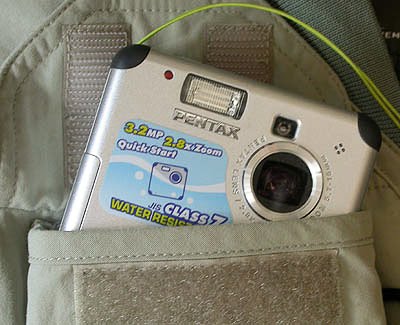
My old Pentax 33WR has been my constant companion while flyfishing, ever since I bought this first-generation water-resistant digital point-and-shoot in the spring of 2004.  This 3.2 megapixel camera probably couldn't be sold for more than $50, but it treads where other cameras wouldn't dare.  It fits nicely into my flyfishing vest and is waterproof enough to have survived at least two complete dunkings.  The last time was two years ago when I slipped off a rock and landed on my back in about 4 feet of water.  I went back to the car to get into dry clothes and realized it had fallen out during the spill.  By the time I retrieved it it had been submerged for about 30 minutes.

One of the things I like about it's feature-set is that there is no option but to shoot in Auto mode.  If it had P,A,S and M modes I probably would spend too much time tinkering.  What a relief it is to merely point the camera and press the shutter. There's even an optical viewfinder should the light be too bright to see the little (and crummy by today's standards) LCD.


For megapixels, 3.2 mp are plenty.  I have made some very nice prints from this camera as large as 9" x 12".  And for a computer monitor or Web use, 3 mp is more then plenty. For example, the maximum size that can be displayed on my 24" monitor is about 2 mp.  And the images below are shown at about 400x650 pixels, which is about 250,000 pixels which is .25mp (that's 1/4 of 1 megapixel!).  And since each pixel is about 2x as large as each of the 10mp on my high-end Canon S90 point and shoot with its slightly larger sensor, the Pentax files do quite well in post processing.  I presume this is because bigger pixels collect more light and therefore more information.

Note the underside of the bridge in the final images.  I was shocked at how easy it was to open the shadows under the bridge (I used Viveza 2.0 software) without adding noticeable noise.  I included the "before" shot as well.


After the underside shadows were opened up with Viveza 2.0 software.  (I also punched up the colors a bit in lightroom.)

Before post-processing

7.24.2010

An ergonomic workaround for the Canon S90

The Canon S90 is a wonderful compact camera.  I take it everywhere and use it when a dSLR is inconvenient or intimidating.  In particular, for images that have strangers in it (and for what is called "street photography") I find the S90 to be unintimidating to others and less likely to draw attention to me. (tip: for real stealth, turn off all sounds).

But the S90 has the same problem that many compact cameras have.  It is sometimes hard to hold.  The S90 is particularly problematic because there are not ribbed or "nubbied" rubber areas to place your fingers.  Even with the aftermarket grip I glued onto the hand-side of the body, I did drop the camera once.  It is very slippery.

Yes, I can use the included strap, but I find straps annoying.  I have pulled pocket cams out of my pocket before, with the strap entangled with my keys. Or, if the strap is hanging out of your pocket it can catch on door knobs and the like, pulling the camera out of your pocket.  It isn't a lot of work, but I really dislike wrapping the stock strap around the camera before slipping it into a pocket. With the contraption shown here, I have solved all these problems.

It is made with a length of old fishing fly-line and a button.  I just slip the button between my fingers and I can operate the camera and adjust buttons and operate the spin dial with my thumb without fear of dropping.  A video would be cool, but the last picture is a result of spinning the camera 180 degrees along its axis with the thumb and fingers of my right hand... importantly, without fear of dropping it!


7.12.2010

Everyone likes blue sky and puffy clouds

I loved the view of the clouds from this bridge, so I eagerly parked the car and walked back to the middle of the bridge.  This is a good example of why I (almost) always keep a camera with me, and is why even the most serious photographer should (IMO) own a decent pocket camera. The camera I used for these images is the 7 ounce Canon S90.

These shots were taken in the P-mode with about 1-stop of negative EV compensation.   This reduced the exposure so that the blue sky would maintain its deep color.  All were shot in RAW and converted to jpegs in Lightroom. 


7.10.2010

It's all about the light

We all know how important the light is when it comes to getting an image with impact.  I was going through a few images from my Colorado trip this past fall.  These two were taken in the morning (about 7:30am) in Rocky Mountain National Park.  I would not have remembered that they are both of the same Elk bull, until I looked at the exif information and discovered that the images were taken about 1 minute apart.  The sun had not yet lifted itself over the mountains to the east when I took the first image, as you can barely see a shadow.  But by the next minute the bull was bounding over a nearby hill to chase away an intruding bugling bull on the other side, and as he reached the top his body picked up the early morning sun.  Your mileage may vary (especially since the first image seems slightly sharper) but to my thinking the second image has far more impact.


The light is better here (but admittedly the composition is too.)