11.17.2012

Sony NEX-6 plus 16-50mm v. LX5 at 50mm equiv.

This is my third post about the Sony NEX-6 and the new pancake 16-50 kit lens.  In the previous post I started comparing it with my beloved Panasonic LX5.  Albeit, the two are strange bedfellows as the LX5 is a small sensor 10mp camera and the NEX has that nice 16mp APS-C sensor. But in many ways the NEX plus pancake zoom is just a bigger version of the LX5.  Perhaps 60% heavier and 60% bigger, but with a very similar zoom range.

In the prior post I compared the two at 24mm equivalent.  Sony seems better in the center and at the edges.  But to be honest, when viewed as big as  possible on my 24" HD monitor (1920 x 1080) or my large HD TV, I really can't tell the difference when viewed at normal viewing distances.  Either way, both images need to be downsized to about 2mp to be viewed on a monitor or HD TV (1920 x 1080 equates to about 2 million pixels or 2mp).  My guess is that even a 10" x 15" print would not show the difference if viewed about 24" away. All that being said, all the picture I took were done in good light with the Panasonic ISO at its lowest 80 and the Sony at its lowest 100.  All bets are off when the light goes down.

Today's images

The images below were taken hand held at 50mm equivalent. At this setting, the  LX5 is at its best at F4. The 16-50 at 50mm-equiv is at its best at F8 and at its worst wide open at F5. I used the lowest ISO: 80 for the LX5 and 100 for the Sony. I shot RAW, used Aperture Priority and Auto White Balance. What you'll see below is that even at its worst (F5), the Sony is sharper than the LX5 at its best (F4).

Post Processing

I imported the RAW files from both cameras into Adobe Lightroom 4 (LR4). I used the default Adobe color profiles. Unlike my experience with the Sony RAW file at 24mm-equiv, I did not correct for any distortion as I didn't really notice any.  To match the incamera JPEG, I moved the LR4 distortion slider modestly, to +5.

I then added sharpness and clarity to both images. The Sony took more sharpening than the Panasonic without looking crunchy, so the Sony got a bit more sharpening. I also using the CA tool to get rid of the purple or green fringing in high contrast areas like tree branches.

Finally, I downsized the Sony to the size of the Pany and created JPEGs at the 100% quality setting. That meant a pixel width of 3776.  The JPEGs were brought back into LR4, and I used the X-Y comparison tool in the LR4 Library module to view the images side-by-side at 100%.  These are screenshots.

For 50mm equivalent field of view, my conclusion is that even at its worst (wide open at F5), the Sony beats the LX5 at its best setting (F4).


The comparative image.  Sorry they don't line up too well.
These were handheld.
The Sony is on Left.  Click on image to view BIG.


Upper left corner: Sony sharper
Click on image to view BIG

Upper right corner: Sony sharper

Lower left corner: Sony sharper

Lower right corner: Sony sharper


11.15.2012

NEX-6 plus 16-50mm v. LX5 at 24mm wide angle

In my previous post I mentioned my recent purchase of the Sony NEX-6 and the new pancake 16-50 kit lens.  On the Internet there seems to be lots of negative talk about this new lens.  Because it is one of the reasons I bought the NEX-6, I decided I would see how it performs against my most similar camera/lens combination, the Panasonic LX5. The LX5 has an equivalent zoom range of 24-90, and the Sony 16-50 has an equivalent zoom range of 24-70. The LX5 has a much smaller sensor, so I am pretty sure I could crop a 70mm image taken with the Sony to the size of the LX5's 90mm image and actually have a larger file size and more detail.  I'm looking forward to checking that assumption out.

The LX5 weighs 10 ounces including card and battery.  The NEX-6 plus 16-50 weighs 16 ounces.  The NEX-6 is bigger in size: while the LX5 is marginally pocketable (unless you wear tight jeans), the NEX-6 requires a jacket pocket.  I am thinking of using one of the new sling-straps, since I dislike neck straps.

The Panasonic is a small sensor camera so is at a disadvantage when it comes to image quality, but I have always found the images sharp (or at least "sharp enough").  If the new Sony pancake is at least as sharp, then I will be happy.

I will start posting some comparative images. 

Today's images

The images below were taken at 24mm equivalent.  The F-stop range shared in common by the LX4 and the 16-50mm lens is F3.5 to F8.  I know from my own two year use of the LX5 and from the Imatest results on the Internet that the LX5 is sharpest at F4, pretty much throughout its zoom range.  The 16-50 at 24mm-equiv seems to be at its best at F5.6.  I used the lowest ISO: 80 for the LX5 and 100 for the Sony.

Post Processing

I imported the RAW files from both cameras into Adobe Lightroom 4 (LR4).  I used the default Adobe color profile. I ran distortion control on the Sony RAW file (as it was not corrected in Lightroom) with the distortion slider set at +50.  This resulted in a RAW file that duplicated the composition of the Sony incamera JPEG.  And it matched the corrected LX5 file. 

I then added sharpness and clarity to both images.  The Sony took more sharpening than the Panasonic without looking crunchy, so the Sony got a bit more sharpening.  I also using the CA tool to get rid of the purple or green fringing in high contrast areas like the tree branches in the upper left.  Interestingly, just clicking on the box in LR was all that was needed for the Sony.  But with the Pany I had to use the eyedropper to remove CA.

Finally, I downsized the Sony to the size of the Pany and created JPEGs at the 100% quality setting.  The downsizing meant that all the JPEGs measured 3776 pixels wide.  The JPEGs were brought back into LR4, and I used the X-Y comparison tool in the LR4 Library module to view the images side-by-side at 100%.

My conclusion is that when the Sony is at its best setting (F5.6 and ISO 100) it beats the LX5 at its best setting (F4 and ISO80). Both in the center and especially at the edges. My guess is that as light is reduced that the difference in image quality will become even greater.

Winner at 24mm is the 16-50 on the NEX-6.


The Sony is on top.  When the original image is viewed full size
on my computer monitor at normal viewing distance I
really can't tell the difference in sharpness.


These are 100% crops from the center.  Sony on top.  Not much difference.
 
These are 200% crops.  The Sony is on top.  The difference is a bit more obvious here.
Look at the greater detail in the roof tiles in the Sony image.
 

100% crops from the righ hand edge.  Sony on top, is sharper. And smoother.

100% crops from the left hand edge.  Sony on top, is sharper.

 
Next: comparisons at 50mm equivalent field of view.

11.12.2012

Why I bought the NEX-6 plus 16-50 kit lens

Why? Well, actually I wasn't completely clear on "why" until I wrote this post.  Since I already own an Olympus EM-5 with an assortment of lenses plus a Panasonic LX5 to fit in my pocket, I know the NEX-6 will not make me a better photographer.  But I am nevertheless drawn to it.

First to come to my mind is that I have liked small range-finder style cameras ever since using my dad's old German-built Kodak Retina IIIC 35mm film camera. Also, I prefer using an eye-level viewfinder, and the Sony is currently one of the two cameras in this class that have one.  Fuji is the other.


1955 Kodak Retina IIIC and 2012 Sony NEX-6


The first NEX was not of interest to me because, though it had a high quality LCD, it lacked an eye-level EVF. The other problem I saw was not-so-high-quality lenses (at least compared with what was available with the m43 system). The lenses were also pretty large and therefore seemed out-of-balance on the very small NEX bodies.

Well, the new NEX 6 has a state-of-the-art EVF and a new kit lens. I received mine last week, just two days after it became available at BHPhotovideo. The new kit lens is a "pancake" zoom lens, and measures only 1" long when retracted (1.25" with lens cap!) It weighs only 4.1 ounces.  I love the new lens' 12-50mm range (24mm to 75mm equivalent), especially the 24mm wide angle. If Sony were only offering the more traditional kit zoom range of 18-55 I would have passed on the entire kit.

With the NEX 6 body I only paid an additional $150 for the lens, which when purchased separately retails for $300. Alternatively, I could have paid $400 for the Panasonic pancake zoom with its effective field of view of 28mm to 90mm. The Panasonic lens is fully compatible with my Olympus EM-5. It's a small lens but lacks the 24mm wide angle I find so useful.

Another choice is the perhaps more useful zoom range of the new Olympus 12-50mm zoom with its effective field of view of 24mm to 100mm.  But this lens measures 3.25" and weighs 7.1 ounces. Even on the smallish EM-5 this is not a small package.

So, the NEX-6 and kit 16-50mm (1) is a small package considering the APS-C sensor, (2) has a superb EVF, and (3) balances nicely with the new pancake zoom that starts with an equivalent 24mm wide angle.

All that being said, I want to be sure the lens has adequate sharpness. I worry about this with any kit lens. It doesn't have to be super sharp, but it does need to be "sharp enough".

I will be testing it first against my beloved Panasonic LX5, an advanced-featured compact camera. I have been very happy with the images I get from the LX5 with its Leica 24-90mm lens. I am very curious as to how these cameras will compare with regard to sharpness.

But beyond sharpness, I have no question that the Sony with its vastly larger sensor will provide greater dynamic range and color depth.  Too, the Sony should provide more detail in low contrast areas, such as grass. I expect from what I have read on the DxO Web site that the Sony will have 3 stops better low light performance (i.e. less noise), though the LX5 will gain back 1.5 stops of low light performance due to it's 1.5 stops faster lens (example: LX5 has a F2 lens at 24mm while the Sony has F3.5).

I look forward to posting some of my findings in hopes that this will help others.

Panasonic LX5 and Sony NEX-6


Assuming the lens passes my quality tests, my plan for this camera is to use it as a jacket-pocketable camera for landscape and travel pictures. I am also becoming increasingly interested in street photography. Because I feel a bit anxious while photographing people on the street, I am hoping the small size of the NEX 6 and pancake zoom will make my actions less obvious.

11.04.2012

My Favorite Fishing Pictures from 2012

I enjoy spending a few days each summer fishing the small coldwater streams of northern New Hampshire (Mt. Washington area) for native trout. Pictured below are six images from July 31st, 2012.  Seen in some of the images is Jim, one of my fishing buddies.

What a beautiful day we had. It was a blue ribbon day. But none of these images are prize-worthy.  They are taken in the middle of the day, there're shadows and bright reflections off the rocks, and sometimes I was shooting nearly into the sun.  And all with a very small sensor point and shoot camera, the waterproof Panasonic TS3.


One reason I like these so much is not the image quality but that they remind of a fabulous day fishing with friends.  I'm also a sucker for bright blue skies... which, by the way, are often the most blue during the middle of the day when the "pros" tell you not to bother shooting. 

Yes, the six images below are very similar in composition, with a wedge of sky above the stream and green foliage on the sides.  I couldn't decide which ones of the six I liked best so I posted all six!

If you want a closer look, click on any image and you'll get a view up to 4x the area, depending on the size of your monitor.


10.16.2012

Which image would you pick?

This coming month's theme in my photo club is "country/rural setting".  I don't have much, especially since I am trying to find something since April.  For some reason, I feel there must be a human or man-made element in the image.  Maybe that's the wrong interpretation, but that's what I am going with.  Which one of these works the best?  (Of course, that's not to say that any will win any prizes, but I do like to participate in these "theme" contests.)

Shoot me an email or add a comment below if you can help me choose the best one.  These are 650 pixel wide images.  If you click on them you can see a larger, 1500 x 1000 pixel version.

House by the Water

Flyfisherman on a Trout Stream

Cabin near an Estuary

RV in the Rockies


10.15.2012

First good sunrise in Maine

It wasn't until our second morning in Maine that we had a nice sunrise.  It wasn't your classic red sky.  But since it had been raining all day and night, I was shocked to see the clouds start to blow over revealing blue sky.

I got a late start to the beach.  I like to get there about 30 minutes before sunrise (sunrise is about 6:30) and to stay for another 30 minutes after the sunrise.  That to me is a very magic hour.  I love watching the colors develop.

This image was taken about 7 a.m.  But with that bank of clouds, the sun really wasn't visible until a few minutes after this shot was taken.  But I did like watching the suns rays melt right through the clouds in the middle of the picture.  And the clouds above were picking up some of the golden light.


10.14.2012

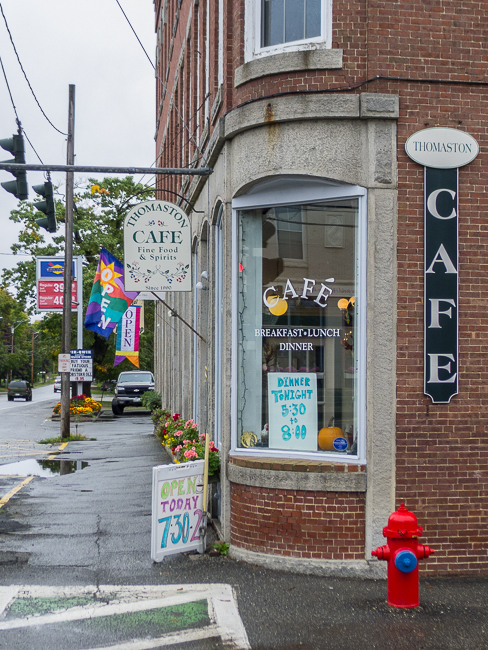
The Thomaston Cafe, Thomaston, Maine

Here are a few pictures of the Thomaston Cafe, which I took when we stopped for lunch last month on our way further up the coast of Maine for a vacation.  The Thomaston Cafe is a nice stopping point about half way into our 6 hour journey to Cape Rosier.  We had sandwiches made on their own homemade wheat bread, and I had a piece of apple pie. Try their crab quiche.  Yummy.  Or, an other item from their long list of daily specials.


9.23.2012

Photo club pictures for October

I've submitted the following three images to my photo club for the October salon (i.e. contest/competition). 

The special category this month is "street scenes/people", and I have submitted two images for this category.  I am not much of a street shooter so I don't really know what "street scenes/people" means.  These two images certainly don't look like "street people" the way I usually think of the phrase.  But they are certainly "people on the street".  Hopefully the judge will find they fit the category.

Both were taken one morning on the streets of Banff, Alberta, Canada.

Full EXIF information can be obtained from the larger images posted on my Web site here:
http://www.peterfraileyphoto.com/p354549645

Young Photographers

Reading the Newspaper


I really like this flower image, and I submitted it for the "open" category.  Because this is a cultivated flower, it is my understanding that this does not fit the requirements for a "nature" category image.

I think orange (or red, depending on how your monitor is calibrated) and green make a very nice combination of colors.  I like the blurred background which keeps it from being distracting.  And I think I captured a good exposure on the bee, as I can even see a bit of orange/red being reflected off the underside of the body.
 

Bee on Flower


9.21.2012

Captured this afternoon

After working indoors most of the morning, I decided after lunch it would be a good time to work out in the yard.  At this time of year it is best to avoid mosquitos (the pests seem to be carrying more diseases these days), and mid-day is usually a time when the mosquitos are sleeping (I made that up) somewhere in the woods. 

I sat down on the front steps to tie on my sneaks and looked up to see a gloriously rich blue sky and interesting streaks of clouds.  Of course, I had to see if I could capture anywhere near the correct color with my camera.  I grabbed the Olympus with 14-54 lens and took several exposures of this scene.  This one was the best IMO.


9.16.2012

Southern Maine Coast

Laurie and I were up in Maine yesterday to visit family.  The weather was wonderful.  The air was dry and the temperature was about 70F.  After our morning visit we decided to take a little excursion, driving the coastal route from Kittery Point to Ogunquit.

These are all mid-day photos.  Usually that is supposed to be a "bad" thing because the light is harsh and the shadows deep.  But I love the colors I was able to get.

The lighthouse seen in two of the shots is Nubble Light.  It is also called Cape Neddick Light.

The camera/lens combination was the Olympus E-M5 and 14-54II zoom lens.  These four images were cropped to a 2:1 aspect ration while processing the RAW images in Lightroom 4.