1.31.2016

The golden hour on the way home from work

I'm sure my iPhone would have done a decent job with this scene, but I'm glad I take a serious camera with a nice zoom with me going back and forth between home and office. This was slightly cropped from the 28mm equivalent wide angle end of my zoom lens... which pretty much is the same as the 30mm equivalent of my iPhone camera.


... I was driving over the Concord River at about 4 p.m. and saw some nice golden light as the sun went below the tree line behind me. Conveniently, and just in time, there was a boat landing with parking off to the side of the road. I say just in time because in less than a minute the light on the trees on the other side of the river was gone. 


1.28.2016

I hadn't used the Panasonic 35-100 F2.8 zoom in a year

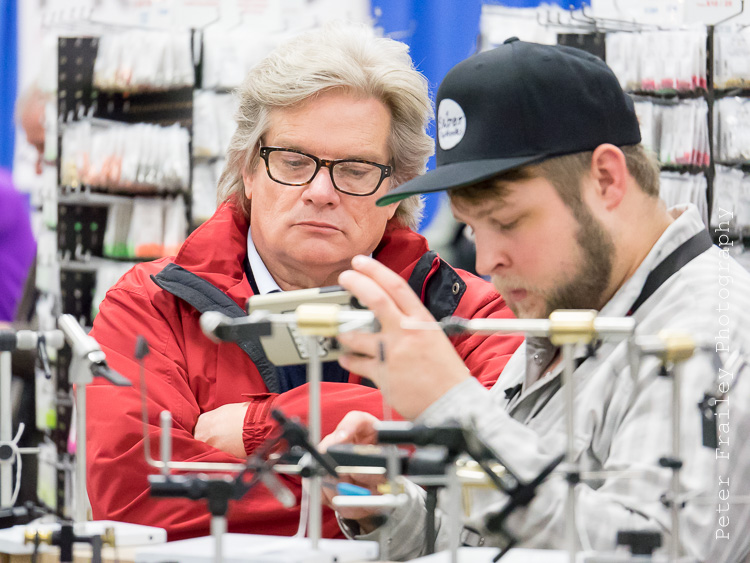
Last weekend I took the Panasonic 35-100 mm zoom (70-200 mm equivalent on a Panasonic or Olympus digital camera) to the annual Fly Fishing Show in Marlborough, MA. I should use this lens more often. It's relatively small and light for an F2.8 lens (just 12.7 ounces and 3.9" long). Because it has internal zooming, it does not extend or "trombone" like so many lesser lenses. I think this actually makes it easier to hold steady.

Panasonic 35-100 F2.8 attached to an Olympus E-M1


I found in looking at my Lightroom catalog of images that the last time I used this lens was a year ago.  It was at the same event, on the same weekend in January. I guess because I don't do much people photography, this lens is a bit of a niche player for me, and so doesn't get a lot of use.  But I do love it!

While I walked around the show randomly photographing people I could see why this focal length range is so important to wedding photographers. I took all my photos at the maximum  F2.8 aperture so as to isolate the subject (i.e. blur backgrounds and foregrounds), something I could not have done with the kit 40-150 F4-F5.6 zoom.  Not to mention that even at F2.8 I sometimes needed ISO 6400 for a decent exposure. 

[You might wonder why I don't take this lens with me for landscapes and travel. Well, 70% of my travel needs are quite adequately taken care of by the Olympus 12-40 F2.8. For the rest, the kit 40-150 mentioned above is quite satisfactory.  It provides a bit more reach too. As expected, for a slower lens, it is even smaller and lighter than the 35-100.  And because I'm usually shooting at F4 to F8 for depth of field purposes, an expensive, heavier, bigger lens is unnecessary.]  

Here are a few of my favorites from the Fly Fishing Show:

The first four were taken at ISO 6400, F2.8 and shutter equal to 1/equiv. focal length.


The next nine were taken at ISO 3200 to 5000


Taken between ISO 500 and 2500


1.22.2016

Why I like my Olympus E-M1 more than my Sony a6000


In 2015 I wrote several posts about why I prefer my Sony a6000 over my EM-1. All that I wrote then remains true, but now it's time to reverse things. There are also reasons why I prefer the EM-1 more than the a6000. That's why I own both!  Because of the three items listed below, it is the EM-1 that is more likely to come along on vacations and excursions.

The Olympus system has three things going for it that trump the Sony a6000 for general all-around use.

In no particular order:

1.  Dual dials on the top plate. I use the front dial easily and nearly continuously to adjust EV compensation. The Sony has just one top dial and it's a thumb dial, with the second dial being the back dial (on the back side of the camera).


2.  A fabulous histogram. The Olympus live histogram is the largest I've used, and is very detailed with a red warning on the right side for all pixels that may be blown out (i.e. white with no detail). As you can see below, the histogram shows in red that a few pixels are "blown", which I presume are specular highlights off the plastic bag in which some of my fishing fly tying materials are stored.  Note too that the histogram sits at the bottom of the middle of the frame. This is where I can see it best. The Sony histogram sits on the bottom right side.  Because I wear glasses (I can't get my eye as close to the EVF as non-wearers) it is difficult for me to see the all-important right side of the histogram on the Sony. No problem on the Olympus. With both cameras the histogram is grey, but the Olympus has a useful "histogram-within-a-histogram": in green it overlays the gray histogram with a "sub-histogram" of what the center focus point is metering.  It's like having spot metering and matrix metering at the same time!


3.  Lenses. The mFT system has beautiful zoom and prime lenses, and there are so many excellent ones to choose from. I only have a few; however, they cover a wide range of needs. The 12-40 "Pro" F2.8 zoom takes care of 70% of my focal length requirements. It is sharp across the frame, and like many Olympus zooms it even has awesome closeup capabilities. Like the EM-1 body, it is weather-proofed. More recent purchases include the Panasonic 35-100 F2.8 and the Panasonic 14-140 "travel" zoom. For primes I have the Olympus 25mm f1.8 for low light situations. Mostly this sits in the bottom of my bag for emergencies, but it weighs just a few ounces. I also have the 60mm f2.8 macro. I love macro!

My two primes:  The 25mm (50mm equivalent) weighs only 4.8 ounces and is 1.4" long.
The 60mm macro (120mm equivalent) weighs only 6.5 ounces and is 3.2" long.

My three zooms.  The Panasonic "travel zoom" on the left is the newest and has not yet seen much
use.  But it will!  The 12-40 "Pro" zoom is in the middle.  The 35-100 F2.8 panasonic
is on the right.  This is the only zoom I own with internal zooming; that is it remains the same
length throughout the zoom range.

4. The Olympus IBIS (in-body image stabilization) isn't necessarily better than the OIS (optical image stabilization) on the Sony, but one advantage of IBIS is that when I use old manual lenses, they are instantly stabilized. This means my 50 year old Nikon 58mm F1.4 lens is fully stabilized when used on the Olympus! There is also an advantage with new third party lenses, like the Sigma 30mm and 60mm both of which I own in E mount for the Sony.  They are not stabilized lenses.  However, if I instead owned the same two lenses in the mFT mount (which is available) they would be stabilized on the Olympus because of the in-body stabilizing system.

Firmware 4.0

I may have to expand the above list.  I recently downloaded the new firmware 4.0. It has some really nice features that appeal to me.  I decided I don't particularly like the new silent shutter option for general use, but there are situations where it will prove helpful. I am excited about the focus stacking and focus bracketing features in particular. But I haven't used either in any serious way...yet. 

10.26.2015

A few final (?) fall images.

I took some time on Friday to jump in the car to look for some final fall foliage.  It was a bit cloudy and windy, and leaves were falling fast, but I did at the very least find some spots that might yield good images next fall.

The lack of light was generally a problem because the clouds were thick.  Even bright colored maple leaves need light from the sky to be at their best (generally).

Below are five images I decided keep.


10.24.2015

Golden hour images on the coast of Maine

These images go back a couple of weeks to a week my wife and I spent in a cabin on Penobscott Bay in Maine.  We've been there a number of times and it does seem that I take fewer and fewer pictures.  But I still like getting up to see the sunrise with my camera in my lap.

One nice thing about October sunrises is that they are so much later than summer sunrises.  It's so much more civilized to get up and ready for a 6:45 sunrise...nearly an hour later than when we visited the same area in August. Generally, too, the air is cleaner, though this year it was cold enough all week so that many of the cabins in the area (including ours) had active wood stoves emitting smoke that wafted across the cove.

Interestingly, the sky most morning (exceptions below) was so clear of clouds that the sunrises, though absolutely beautiful, were not particular awe-inspiring from a photographic standpoint.  Don't get me wrong.  I enjoyed each of them!

The first and last images were taken during the evening "golden hour". The middle three were taken during the morning "golden hour". All were on different days.

Five of my favorites from the trip:


10.20.2015

A couple of fall iPhone shots

Sometimes it pays to get off the highway.

I was trying to get to my dad's nursing home for a visit last Friday, when I came upon a huge traffic back-up on the three lane highway I was traveling. My solution was to get off at the next exit. I meandered my way through the rural countryside around Bolton, MA.  The scenery was beautiful, though fall foliage was probably a week short of "peak".

The only camera I has was the one on my iPhone.  Here are two shots I liked.  Other than perhaps being limited by the wide angle (equivalent to 30mm on a full frame camera), I was limited in these two images by wire cattle fences or "no trespassing" signs.


In the image below, if you follow the line of clouds into the distance you will come to Mt. Wachusetts near Worcester, MA.

10.12.2015

An old Ford and an old Chevy. Sometimes you just get lucky.


This was taken in Searsport, Maine during a recent vacation.  We always stop at the Dunkin Donuts behind the Sunoco station for an afternoon pick-me-up cup of coffee after many hours of driving along the Maine coast.

(Of course, I am now kicking myself for parking my silver van so close.  You can see it on the left.)


Another angle


10.01.2015

First shots with the old Minolta 100mm macro plus Sony A6000

In my prior post, I talked about my experience with an old Minolta 100mm macro lens on my Olympus E-M1.  With this adapted lens, I felt there were some focusing challenges with the Olympus that resulted in fewer "keepers" than I had hoped for.

It seemed to me that the lens was very sharp, and I certainly enjoyed its smooth action.  But I missed focus more than I was prepared for.  In other words, sometimes the area that turned out to be in focus, when viewed on my computer, was slightly off from the area I intended to be in focus.

Missed focus is inevitable with flowers out doors.  It was caused by either my slight movement or the movement of the flowers, or both.  A tripod would have prevented camera movement but not flower movement.  Bringing the flowers indoors and using a tripod would obviously have been a solution.  But to my way of thinking, it wouldn't have been much fun.

The reason I wanted to try this same lens on the Sony a6000 is that the Sony has focusing assistance that is, in some ways, the opposite of what's available on the Olympus.  I feel that with Olympus, there is too much lag between achieving focus and releasing the shutter.

Sony A6000 plus Minolta 100mm F3.5 macro plus Nissan i40 flash


Bottom Line:  I think I get more accurate results with the Sony.

Here are the differences in how one focuses these two camera bodies, at least when using adapted manual focus lenses.

1) Focus Peaking:

a) The Olympus focus peaking, when shooting macros, shows too great an area in focus... more than what actually is in focus.  The Sony focus peaking shows a narrower and more accurate (IMO) area of focus, though if there is not enough contrast, sometimes the peaking does not work at all! Again, I'm only concerned here with macro focusing.

b) The Olympus focus peaking works when the shutter is unpressed.  However, it disappears when half pressed, leaving an operator time-lag between focus and shutter release.  The Sony focus peaking works when the shutter is unpressed, but continues to work when half pressed. The photographer can therefore ride the shutter button half-pressed while focusing.  This reduces operator time-lag between focus and shutter release.

2) Magnification:

a)  Both systems offer magnification choices.  The Olympus allows magnification of 3x, 5x, 7x, 10x and 14x.  The Sony offers 5.9x and 11.7x.

b) The Olympus maintains the magnification all the way through the shutter press.  This helps me maintain focus.  However, you are unable to see your overall composition.  The Sony loses magnification at the half press which makes me feel I've lost focus.  On the other hand because it pops to full view when half pressed, I am able to confirm my composition.  For landscapes, I would prefer the Sony choice. YMMV.

A few sample images: