10.23.2017

Schooner "American Eagle" out of Rockland, Maine


After taking the photo below I wanted to identify the schooner.  I couldn’t quite make out the name across the bow even when zooming in on my computer monitor; but after spending some time with google and photos of the various cruising schooners around Camden and Rockland, Maine it became obvious that this is the “American Eagle”.


The American Eagle was built in Gloucester in 1930 and was the last fishing schooner built there, this being an auxiliary schooner as it was (and is) powered by both sails and engine.  She is listed in the National Registry of Historic Places (as of 1991) and is a National Historic Landmark (1992).  I have read that she is the last known surviving vessel of this type.  She is 92 feet long on deck and about 20 feet wide.  Outfitted for passengers, looking at the schematic diagram on the Web site http://www.schooneramericaneagle.com, I counted thirteen double-occupancy passenger cabins.

She was purchased by John Foss in 1984 and converted for cruising, spending summers in Penobscot Bay (where I took this photo) on 3-7 day cruises.  I have included below some details from the Web site.  Interestingly, I read in “Yacht World” (I can’t figure the date of the posting) that the schooner is (or at least was) for sale for $750,000.


10.21.2017

Moody's Diner For Lunch, Waldoboro, Maine

Moody's Diner started as a lunch wagon on old Route 1 in Waldoboro in 1928.  (However, Moody's started operation the prior year when Percy and Bertha Moody began offering three cabins to travelers for $1 per night.)  The lunch wagon has expanded over the years to its current size.  Even today, it is family operated and employees include children, grand children and great-grand children!

We find more and more that our trips to Maine are timed to reach Moody's for lunch.  There is usually a line but it moves quickly.  Often there are spots at the counter available for your immediate occupancy.

Sometimes I get a basic hamburger and fries.  On this day, it was a bowl of fish chowder and warm biscuit.  A slice of fresh pie is mandatory, with wild blueberry being a staple.  (Though the slice shown here is 4-berry pie, as I decided to be a bit adventuresome!)

If you are driving along Route 1 north of Bath, you simply must stop at Moody's.  It's a classic.


10.19.2017

A Visit to the Farmers' Market, Bath Maine

On our drive up the Maine coast a couple of times a year, we have taken to spending a night or two in City of Bath (population 9,000).  Known for the Bath Iron Works, Bath has a quintessential Maine downtown area on the north side (upriver side) of the Route 1 bridge, with BIW being on the south side (ocean and downriver side) of the bridge.  

The nearly 3,000 foot long Sagadahoc Bridge over the Kennebec River as viewed from Waterfront Park.
On the far side of the bridge is the town of Woolrich, Maine.


Our stops in Bath have usually coincided with the Saturday Farmers' Market, which sets up at Waterfront Park, from 8:30-12:00, May through October.  (The winter indoor venue is about a block away, November through April.)

Though the veggies always look great, we are more likely to leave with local cheese and bread. So far, I've avoided the pie vendors.  Maybe next time... I can't hold out forever.

All photos below were with the Olympus E-M1 and 12-100mm zoom.


10.17.2017

A Quick Visit To Reid State Park, Maine

Reid State Park is Maine’s first state-owned saltwater beach, having been given to the state in 1946 by Walter E. Reid. Its sandy beaches and sand dunes are rare items in Maine.

My pictures were taken on and around Griffith Head, looking north along Mile Beach.  I’m looking forward to returning in warmer weather to explore Half Mile Beach and the Little River.

This is my favorite image today.
Panasonic GX80/85 with Olympus 12-100 @ 100mm
1/6400, F4, ISO 200


The Lagoon (see map) looks like a great place to play for children, as the water is quieter and warmer than the open ocean.


I’m not a birder, but I understand that there are many nesting areas for several species of endangered birds. Least terns and piping plovers were mentioned in several references.

Also fun to watch would be surfing.  The Boston Globe Magazine rated Reid State Park as #1 (in 2015) in New England for surfing. We did see one surfer way in the distance.


The best looking beach plums I've ever seen!

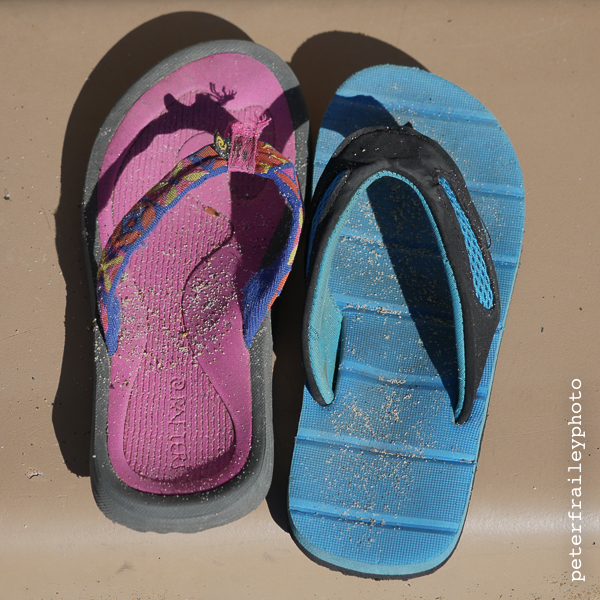
Saw this mismatched set on the beach.  I wonder who has the other pair?
Mile Beach


So very healthy
Looks like it might be good for surfing.


10.15.2017

Lightroom Continues To Amaze Me

There are plenty of things which frustrate me about Lightroom.  Mostly it's about the slow downloading speed and the need to wait (lag time?) before you can see each of the changes made with the sliders.

Nevertheless, every time I move the highlights, whites, and shadows sliders I am amazed with the results you can get from a RAW file.  These sliders were added to Lightroom in 2012, I believe, and to much acclaim.

The two images below are 800 pixel wide files I exported from Lightroom as jpgs.  The scene is that of stacked lobster traps.  I took the picture because I liked the pattern of grids and ropes.

The first image is based simply on the "Adobe Standard" profile that is applied by default on import. The second is the result after using the sliders in the basic panel, in particular the highlights, whites, and shadows sliders... with a bit of clarity, vibrance and saturation to taste. A touch of straightening was applied.

The basic panel adjustments really brought out the colors of the lines and ropes.  Perhaps it looks a bit "over the top", as I don't think I really saw all those colors while I was squinting in the bright light.  Nevertheless I like the look of the processed image.

As far as gear goes, the camera and lens combo was the Panasonic GX80/85 and Olympus 12-100 F4 zoom.  The image was taken on a bright sunny day at about noon, so the light as you can see was very harsh.  Nevertheless, the histogram in Lightroom shows that all pixels were within the dynamic range of the sensor... except the tops of some of the white ropes which were overexposed.

Before

Panasonic GX80/85 with Olympus 12-100 @28mm (56mm equiv)
1/80sec, F8, ISO200
 After


9.25.2017

Philosophical About Fall Maple Leaves

Over the weekend, while mostly lying on my back watching football on television after a back sprain earlier in the week, I decided I needed to go outside, walk around the property, and see if there were any photos to be had. I needed some fresh air and some camera-time between back exercises!

I thought I might get a nice photo from among the growing number fall-colored maple leaves that had fallen to the ground, and I looked for a perfect specimen as a model. The task was impossible....there were so many that were quite attractive but nowhere near " perfect ". The one below is an example. 

For some reason after holding and photographing this leaf (against a blurred and richly green background which is our lawn), and then admiring its own beauty on my computer screen, I got a bit philosophical.

I thought to myself that the downed maple leaves were a lot like people: each is unique, all have imperfections, and most (many ?) are beautiful in their own way. 

Fall Maple Leaf - Imperfect But Beautiful
Panasonic GX80/85 with 60mm Olympus F2.8 Macro
1/125sec, F4, ISO 200

9.21.2017

Photo+Story: Backlit Flowers on Sunny Days

In my prior post I was bemoaning sunny days when out shooting flowers at our local botanic garden, and I suggested that finding a few flowers in the shade was a good option.  But I thought of something else that worked for me on Sunday.

I remember walking through the gardens looking at flowers and seeing behind the flower beds a group of palm leaves (or similar plant) growing out of one of those big 18" diameter clay pots.  With the powerful sun lighting them from behind they appeared very colorful, and certainly bright enough to attract my attention.  So, I am thinking that backlit flowers would be a good theme or project on sunny days.  I need to remember that for the next time I feel like photographing flowers and it is a sunny day.

For these images I put the Panasonic GX80/85 with Olympus 60mm macro in my backpack, as the prime lens did not have enough reach, and pulled out my E-M1 with Olympus 12-100mm F4.  Even zoomed in at 100mm (200mm equivalent) this image is cropped a bit.  One reason I always bring a zoom with me is that botanic gardens have rules about walking on the paths only. This means if the desired flower or subject is off the beaten path, you have no option but to go for a longish zoom or telephoto lens.

Backlit Palm Leaf
Olympus E-M1 and 12-100mm F4 @ 100mm

1/250 sec, F8, ISO 400

9.19.2017

Photo+Story: Look For Shade On Sunny Days (Flowers)


Well, of course, not always is shade what you want.  But I’ve learned to dislike bright sunshine when shooting flowers.  Without clouds to diffuse the sunlight, the lighting is just too harsh.  And even if you hold a diffuser between the sun and the flower with your left hand while holding the camera with your right hand, there is always the background that will be a mix of bright and dark areas.  I find such a background very distracting, and improving it in Lightroom is time consuming, if not challenging.

So the story is that on Sunday I drove to our local botanic garden in hopes for some nice flowers and photos.  The flowers were nice all right, with lots in bloom.  However the overcast day that I was in hopes of having (for the diffused light) turned into a 100% sunny day almost as soon as I got there. I was not happy with any of the flowers I shot in the sunny conditions.

I did find one bed of pink flowers in the shade of some tall evergreen bushes.  I like the image below. You will see that there a no deep dark shadows on the flower, nor bright or blown out highlights.

With my mFT cameras (Panasonic and Olympus) I generally hope for enough light to shoot at ISO800 or less, and at a minimum shutter speed of 1/250 to account for possible plant movement. It is also be nice if I can get away with a aperture as small as F8, though I typically shoot wider open than that.  I might use F8 (on mFT) for the depth of field, but all too often F8 brings too much of the background in focus. 

Pink Flower
Panasonic GX80/85 with Olympus 60mm F2.8 Macro
1/160 sec, F4, ISO 200


This photo was taken at 1/160sec, F4 and ISO200.  It looks like I was shooting in aperture priority and neglected to see that the shutter speed was below my target minimum of 1/250 sec.  Nevertheless 1/160 was quite adequate for the day’s wind conditions.  Also, I was able to hold the camera very steady because I was sitting on an 8” stool with my elbows on my thighs.

But notice that although the flower was in shade, the background was not in the shade and was a bit blotchy with dark and bright spots... which I find annoying.  I did, however, use the radial tool in Lightroom to darken the area outside of the flower.


9.17.2017

Walk Around: BMW's First Motorcycle - the R32

The R32 was manufactured between 1923 and 1926.  It was BMW's first motorcycle.  It had an 8.5 hp 486 cc engine (about 30 cubic inches), and could reach about 60mph.  I'm not sure how safe it seems, to be taking your hand off the right handlebar to reach the gearshift lever (see wood knob next to the BMW logo).  On the other hand, I spent years riding a racing bicycle with dual derailleur shifters on the downtube without incident.

Here' a link if you'd like to hear and see an R32 (not this specific one) under operation, though not nearly at 60mph.

https://youtu.be/7Ix8I17GzjM


9.15.2017

Photo Story: First Signs of Fall?

After a bit of dark and gloom and rain today, the sun came out in the late afternoon as I went out of the house and down the driveway to the mail box.  The sun had a really nice angle on these well-lichened maple trees in the wetlands beside our house, and it is the neutral colored bark of these trees that made this vine of Virginia Creeper stand out and catch my eye.  The leaves had recently turned a brilliant red, and they were on display in the afternoon sunlight.  As we know, it's all about the light.

I read on the Internet (so it must be true!) that Virginia Creeper is sometimes grown as an ornamental plant because the leaves turn a brilliant red in the fall.  I certainly agree with the red part of that statement.  But it's hard to think of actually planting this vine.  It's much less problematic for us than the Bittersweet vines which wrap around a trunk and eventually strangle a tree.

At least Virginia Creeper grows straight up the trunk.  However, it is all over the place.  The vines grow along the ground sending roots down into the soil, until the vine finds a tree to climb. According to the "Ohio Weedguide" put out online by The Ohio State University, each vine can grow 20 feet per year. No wonder I keep pulling it out of the garden.

Panasonic GX80/85 plus Panasonic 100-300mm @ 300mm
1/640, F5.6, ISO200